Paperback
Featuring designs and patterns based on the Dr. Seuss’s classic Oh, the Places You’ll Go!, this coloring book for all ages is the perfect way to encourage graduates–or anyone making a change in life–to relax and exercise their imagination!


₦18,000.00
Paperback
Featuring designs and patterns based on the Dr. Seuss’s classic Oh, the Places You’ll Go!, this coloring book for all ages is the perfect way to encourage graduates–or anyone making a change in life–to relax and exercise their imagination!
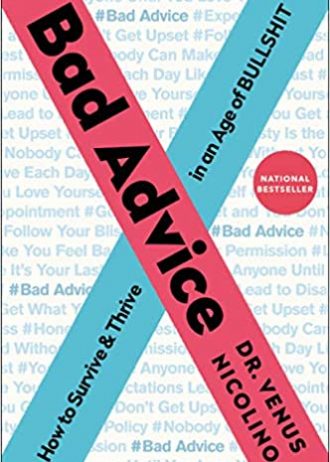
In Bad Advice, relationship expert Dr. Venus Nicolino—a.k.a. Dr. V—takes a blowtorch to the shrink-wrapped, “feel good” BS that passes for self-help these days.
When you’re heartbroken, what do you hear? You can’t love anyone until you love yourself. When someone’s hurt you? Nobody can make you feel bad without your permission. When you’re just a little too positive? Expectations lead to disappointment.
Pop culture noise gives Bad Advice the varnish of truthiness and inspiration. But it’s not truth; it’s not inspiration. It’s bullshit. And at its root, all Bad Advice operates off the same lie: Emotions are optional. In Bad Advice, Dr. V delivers a bracing truth serum, in the form of Good Advice—an antidote to the bullshit, from “Just Be Yourself” to “Live Each Day Like It’s Your Last,” that teaches you to live your life in a way that honors who you are, what you need, and how you feel.
Smart and irreverent, Dr. V fuses the brains and insight of a nerdy Ph.D. with the heart of a doting Italian Mother and the artful profanity of a Philly trucker. Dr. V’s signature combination of humor, hard science, and heart make Bad Advice an iconoclastic course-correction like no other. A fiercely sharp wake-up call that tackles some of self-help’s most damaging truisms, Bad Advice is a never shy guide to tapping into your full potential.
In our fast-paced, success-obsessed culture, we’re constantly tempted to chase after things that don’t matter. We’ve been conditioned to value possessions over people, status over relationships, and ourselves over God.
But the reality is this: God created love to be the centerpiece of our lives.
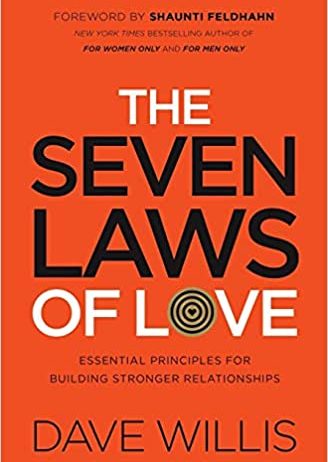
In The Seven Laws of Love, Dave Willis makes the case for a love revival and proves that in returning to a life of love we have no greater model than the one who is love himself.
In Dave’s humorous, touching, down-to-earth style, The Seven Laws of Love takes you on a journey through the ins and outs of everyday relationships—with your spouse, your children, your friends, and your coworkers—using practical, applicable examples and guiding principles that demonstrate what a life of love actually looks like.
There is no higher calling on earth than to love and be loved. It’s time to learn The Seven Laws of Love, and to make loving a priority over all other pursuits. Anything else isn’t really living.
Cocaine is glamour, sex and murder. From the badlands of Colombia, it stretches across the globe, seducing, corrupting and destroying. A product that must be produced, distributed, and protected, it is both a harbinger of violence and a source of immense wealth. Beginning in the jungles and mountains of Colombia, it filters down to countryside villages and the nightclubs of the cities, attracting money, sex, and death. Each step in the life of a kilo reveals a different criminal underworld with its own players, rules, and dangers, ranging from the bizarre to the diabolical. The killers, the drug-lords, all find themselves seduced by cocaine and trapped in her world.
Seasoned war correspondent Toby Muse has witnessed each level of this underworld, fueled by the appetite for cocaine in America and Europe. In this riveting chronicle, he takes the reader inside Colombia’s notorious drug cartels to offer a never before look at the drug trade. Following a kilo of cocaine from its production in a clandestine laboratory to the smugglers who ship it abroad, he reveals the human lives behind the drug’s complicated legacy. Reporting on Colombia for the world’s most prestigious networks and publications, Muse gained unprecedented access to the extraordinary people who survive on the drug trade—farmers, smugglers, assassins—and the drug lords and their lovers controlling these multi-billion dollar enterprises. Uncovering stories of violence, sex, and money, he shows the allure and the madness of cocaine. And how the War on Drugs has been no match for cocaine.
Piercing this veiled world, Kilo is a gripping portrait of a country struggling to end this deadly trade even as the riches flow. A human portrait of criminals and the shocking details of their lives, Kilo is a chilling, unforgettable story that takes you deep into the belly of the beast.
Kilo includes 16 pages of photographs.
She couldn’t have been more than seven or eight years old. “Go ahead, ask your question,” her father urged, nudging her forward. She smiled shyly and said, “You’re my hero. Who’s yours?”
Many people—especially girls—have asked us that same question over the years. It’s one of our favorite topics.
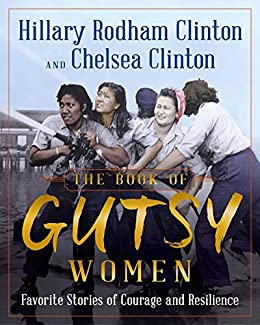
HILLARY: Growing up, I knew hardly any women who worked outside the home. So I looked to my mother, my teachers, and the pages of Life magazine for inspiration. After learning that Amelia Earhart kept a scrapbook with newspaper articles about successful women in male-dominated jobs, I started a scrapbook of my own. Long after I stopped clipping articles, I continued to seek out stories of women who seemed to be redefining what was possible.
CHELSEA: This book is the continuation of a conversation the two of us have been having since I was little. For me, too, my mom was a hero; so were my grandmothers. My early teachers were also women. But I grew up in a world very different from theirs. My pediatrician was a woman, and so was the first mayor of Little Rock who I remember from my childhood. Most of my close friends’ moms worked outside the home as nurses, doctors, teachers, professors, and in business. And women were going into space and breaking records here on Earth.
Ensuring the rights and opportunities of women and girls remains a big piece of the unfinished business of the twenty-first century. While there’s a lot of work to do, we know that throughout history and around the globe women have overcome the toughest resistance imaginable to win victories that have made progress possible for all of us. That is the achievement of each of the women in this book.
So how did they do it? The answers are as unique as the women themselves. Civil rights activist Dorothy Height, LGBTQ trailblazer Edie Windsor, and swimmer Diana Nyad kept pushing forward, no matter what. Writers like Rachel Carson and Chimamanda Ngozi Adichie named something no one had dared talk about before. Historian Mary Beard used wit to open doors that were once closed, and Wangari Maathai, who sparked a movement to plant trees, understood the power of role modeling. Harriet Tubman and Malala Yousafzai looked fear in the face and persevered. Nearly every single one of these women was fiercely optimistic—they had faith that their actions could make a difference. And they were right.
To us, they are all gutsy women—leaders with the courage to stand up to the status quo, ask hard questions, and get the job done. So in the moments when the long haul seems awfully long, we hope you will draw strength from these stories. We do. Because if history shows one thing, it’s that the world needs gutsy women.
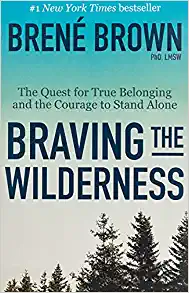
Social scientist Brené Brown, PhD, MSW, has sparked a global conversation about the experiences that bring meaning to our lives—experiences of courage, vulnerability, love, belonging, shame, and empathy. In Braving the Wilderness, Brown redefines what it means to truly belong in an age of increased polarization. With her trademark mix of research, storytelling, and honesty, Brown will again change the cultural conversation while mapping a clear path to true belonging.
Brown argues that we’re experiencing a spiritual crisis of disconnection, and introduces four practices of true belonging that challenge everything we believe about ourselves and each other. She writes, “True belonging requires us to believe in and belong to ourselves so fully that we can find sacredness both in being a part of something and in standing alone when necessary. But in a culture that’s rife with perfectionism and pleasing, and with the erosion of civility, it’s easy to stay quiet, hide in our ideological bunkers, or fit in rather than show up as our true selves and brave the wilderness of uncertainty and criticism. But true belonging is not something we negotiate or accomplish with others; it’s a daily practice that demands integrity and authenticity. It’s a personal commitment that we carry in our hearts.” Brown offers us the clarity and courage we need to find our way back to ourselves and to each other. And that path cuts right through the wilderness. Brown writes, “The wilderness is an untamed, unpredictable place of solitude and searching. It is a place as dangerous as it is breathtaking, a place as sought after as it is feared. But it turns out to be the place of true belonging, and it’s the bravest and most sacred place you will ever stand.”
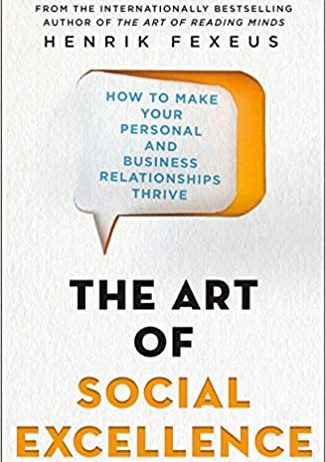
Research has increasingly shown that nonverbal communication prowess is absolutely essential in seemingly unrelated areas of our lives (investment decisions, salary levels, etc.) However, as our society becomes more modernized and we incorporate new forms of technology into our daily interactions, we are becoming less and less capable of understanding one another as we should.
In The Art of Social Excellence, Henrik Fexeus combines his own expert knowledge as a mentalist with psychology studies to create a complete guide to social interaction. He covers it all: from overcoming your conversational fears in a large group of people, to excelling in the workplace, to winning an argument with your partner. He breaks down various rhetorical strategies in detail, and provides helpful steps and checklists for the reader to check their progress in a social encounter.
Anyone who has ever felt awkward or misunderstood in social situations will benefit from reading this book, and with proper implementation of Fexeus’s principles, can achieve superior social skills.

Reviews
There are no reviews yet.