History & Geography

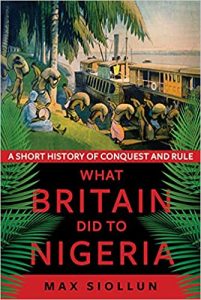
What Britain Did To Nigeria

9,000.00

Most accounts of Nigeria’s colonisation were written by British officials, presenting it as a noble civilising mission to rid Africans of barbaric superstition and corrupt tribal leadership. Thanks to this skewed writing of history, many Nigerians today still have Empire nostalgia and view the
colonial period through rose-tinted glasses.

Max Siollun offers a bold rethink: an unromanticised history, arguing compellingly that colonialism had few benevolent intentions, but many unjust outcomes. It may have ended slavery and human sacrifice, but it was accompanied by extreme violence; ethnic and religious identity were cynically exploited to maintain control, while the forceful remoulding of longstanding legal and social practices permanently altered the culture and internal politics of indigenous communities. The aftershocks of this colonial meddling are still being felt decades after independence. Popular narratives often suggest that the economic and political turmoil are homegrown, but the reality is that Britain created many of Nigeria’s crises, and has left them behind for Nigerians to resolve.

This is a definitive, head-on confrontation with Nigeria’s experience under British rule, showing how it forever changed the country–perhaps cataclysmically.

Basketball: A Love Story

8,500.00

In an effort to tell the complete story of basketball in all its fascinating dimensions, acclaimed authors Jackie Macmullan, Rafe Bartholomew and Dan Klores have compiled nearly a thousand hours’ worth of interviews with a staggering number of basketball greats. They’ve talked to hundreds of legendary players, such as Kobe Bryant, LeBron James, and Magic Johnson, and spoken with renowned coaches, including Phil Jackson and Coach K, as well as numerous executives, commissioners, and journalists. Most impressive was the extraordinary quality of the interviews. Again and again, players spoke candidly about secrets and told stories they’d never before discussed on the record.

The book that grew out of those interviews is an extraordinary project and quite possibly the most ambitious basketball book ever written. At once a defining oral history and something far more literary and intimate, this is the never-before-told story of how basketball came to be, and about what it means to those who’ve given their lives to the game.

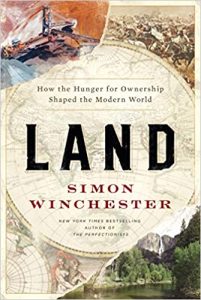
Land

8,500.00

The author of The Professor and the Madman, The Map That Changed the World, and The Perfectionists explores the notion of property—bought, earned, or received; in Europe, Africa, North America, or the South Pacific—through human history, how it has shaped us and what it will mean for our future.

Land—whether meadow or mountainside, desert or peat bog, parkland or pasture, suburb or city—is central to our existence. It quite literally underlies and underpins everything. Employing the keen intellect, insatiable curiosity, and narrative verve that are the foundations of his previous bestselling works, Simon Winchester examines what we human beings are doing—and have done—with the billions of acres that together make up the solid surface of our planet.

Land: How the Hunger for Ownership Shaped the Modern World examines in depth how we acquire land, how we steward it, how and why we fight over it, and finally, how we can, and on occasion do, come to share it. Ultimately, Winchester confronts the essential question: who actually owns the world’s land—and why does it matter?

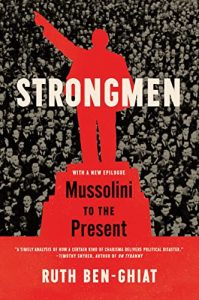
Strongmen

8,500.00

Ruth Ben-Ghiat is the expert on the “strongman” playbook employed by authoritarian demagogues from Mussolini to Putin—enabling her to predict with uncanny accuracy the recent experience in America and Europe. In Strongmen, she lays bare the blueprint these leaders have followed over the past 100 years, and empowers us to recognize, resist, and prevent their disastrous rule in the future.

For ours is the age of authoritarian rulers: self-proclaimed saviors of the nation who evade accountability while robbing their people of truth, treasure, and the protections of democracy. They promise law and order, then legitimize lawbreaking by financial, sexual, and other predators.

They use masculinity as a symbol of strength and a political weapon. Taking what you want, and getting away with it, becomes proof of male authority. They use propaganda, corruption, and violence to stay in power.

Vladimir Putin and Mobutu Sese Seko’s kleptocracies, Augusto Pinochet’s torture sites, Benito Mussolini and Muammar Gaddafi’s systems of sexual exploitation, and Silvio Berlusconi and Donald Trump’s relentless misinformation: all show how authoritarian rule, far from ensuring stability, is marked by destructive chaos.

No other type of leader is so transparent about prioritizing self-interest over the public good. As one country after another has discovered, the strongman is at his worst when true guidance is most needed by his country.

Recounting the acts of solidarity and dignity that have undone strongmen over the past 100 years, Ben-Ghiat makes vividly clear that only by seeing the strongman for what he is—and by valuing one another as he is unable to do—can we stop him, now and in the future.

Highlife Giants

8,000.00

As West Africa’s oldest form of popular music, highlife was the soundtrack of the independence era. Its influence still resonates today.

Highlife Giants is an intimate portrait of the pioneering artistes of West Africa’s music scene from the 1920s onwards. It contains interviews with stars such as E.T Mensah, Kofo Ghanaba, King Bruce, Bobby Benson, Victor Uwaifo, and Ignace De Souza revealing priceless behind-the-scenes moments such as Louis Armstrong giving Eddie Okonta a trumpet with a golden mouthpiece after seeing him perform. Highlife Giants charts the development of this rich and varied popular form which is hugely influential on contemporary West African music from Afrobeat to hiplife.

Blending European and African-American styles with traditional African patterns, highlife music contributed to the development of post-independence national identity in both Ghana and Nigeria. As such, highlife remains crucial in generating social commentary, protest and contributing to the formation of a pan-African musical identity.

For those who lived through the era, Highlife Giants will be a compendium that invokes treasured memories. For their children and grandchildren, this book will inspire an interest in the rich musical history of West Africa

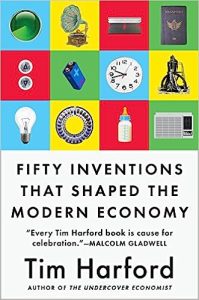
Fifty Inventions That Shaped The Modern Economy

8,000.00

Fifty Inventions That Shaped the Modern Economy paints an epic picture of change in an intimate way by telling the stories of the tools, people, and ideas that had far-reaching consequences for all of us. From the plough to artificial intelligence, from Gillette’s disposable razor to IKEA’s Billy bookcase, bestselling author and Financial Times columnist Tim Harford recounts each invention’s own curious, surprising, and memorable story.

Invention by invention, Harford reflects on how we got here and where we might go next. He lays bare often unexpected connections: how the bar code undermined family corner stores, and why the gramophone widened inequality. In the process, he introduces characters who developed some of these inventions, profited from them, and were ruined by them, as he traces the principles that helped explain their transformative effects. The result is a wise and witty book of history, economics, and biography.

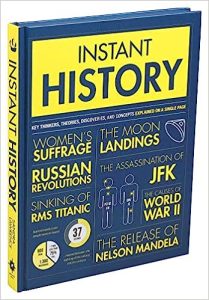
Instant History

8,000.00

Key thinkers, theories, discoveries, and concepts each explained on a single page!

Instant History pulls together pivotal moments from history into one concise volume. Each page contains a distinct “cheat sheet,” which tells you the most important facts in bite-size chunks, so you can feel like an expert in minutes! From second-wave feminism to Stalinism, the invention of the car to the Battle of the Somme, and the Russian Revolution to the Industrial Revolution, every key event, character, or turning point is expressed in succinct and lively text and graphics. Perfect for the knowledge-hungry and time-poor, this collection of graphics-led lessons makes history interesting and accessible. Everything you need to know—and more!—packed into one convenient volume.

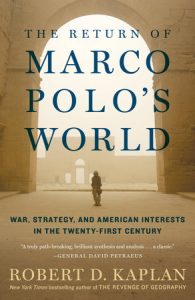
The Return Of Marco Polo’s World

8,000.00

In the late thirteenth century, Marco Polo began a decades-long trek from Venice to China along the trade route between Europe and Asia known as the Silk Road—a foundation of Kublai Khan’s sprawling empire. Now, in the early twenty-first century, the Chinese regime has proposed a land-and-maritime Silk Road that duplicates exactly the route Marco Polo traveled.

Drawing on decades of firsthand experience as a foreign correspondent and military embed for The Atlantic, Robert D. Kaplan outlines the timeless principles that should shape America’s role in a turbulent world that encompasses the Chinese challenge. From Kaplan’s immediate thoughts on President Trump to a frank examination of what will happen in the event of war with North Korea, these essays are a vigorous reckoning with the difficult choices the United States will face in the years ahead.

Sapiens: A Graphic History, Volume 2: The Pillars of Civilization

8,000.00

What if humanity’s major woes—war, plague, famine and inequality—originated 12,000 years ago, when Homo sapiens converted from nomads to settlers, in pursuit of the fantasy of productivity and efficiency? What if by seeking to control plants and animals, humans ended up being controlled by kings, priests, and Kafkaesque bureaucracy? Volume 2 of Sapiens: A Graphic History–The Pillars of Civilization explores a crucial chapter in human development: the Agricultural Revolution. This is the story of how wheat took over the world; how an unlikely marriage between a god and a bureaucrat created the first empires; and how war, plague, famine, and inequality became an intractable feature of the human condition.

But it’s not all doom and gloom with this book’s cast of entertaining characters and colorful humorous scenes. Yuval, Zoe, Prof. Saraswati, Cindy and Bill (now farmers), Detective Lopez, and Dr. Fiction, all introduced in Volume 1, once again travel the length and breadth of human history, this time investigating the impact the Agricultural Revolution has had on our species. The cunning Mephisto shows them how to ensnare humans, King Hammurabi lays down the law, and Confucius explains harmonious society. The origins of modern farming are introduced through Elizabethan tragedy; the changing fortunes of domesticated plants and animals are tracked in the columns of the Daily Business News; the story of urbanization is portrayed as a travel brochure, offering discount journeys to ancient Babylon and China; and the history of inequality unfolds in a superhero detective story; with guest appearances by historical and cultural personalities throughout such as Thomas Jefferson, Scarlett O’Hara, Margaret Thatcher, and John Lennon.

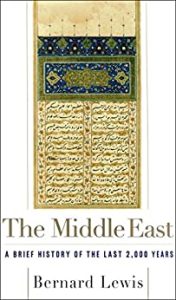
The Middle East

8,000.00

In a sweeping and vivid survey, renowned historian Bernard Lewis charts the history of the Middle East over the last 2,000 years, from the birth of Christianity through the modern era, focusing on the successive transformations that have shaped it.

Drawing on material from a multitude of sources, including the work of archaeologists and scholars, Lewis chronologically traces the political, economical, social, and cultural development of the Middle East, from Hellenization in antiquity to the impact of westernization on Islamic culture. Meticulously researched, this enlightening narrative explores the patterns of history that have repeated themselves in the Middle East.

From the ancient conflicts to the current geographical and religious disputes between the Arabs and the Israelis, Lewis examines the ability of this region to unite and solve its problems and asks if, in the future, these unresolved conflicts will ultimately lead to the ethnic and cultural factionalism that tore apart the former Yugoslavia.

Elegantly written, scholarly yet accessible, The Middle East is the most comprehensive single volume history of the region ever written from the world’s foremost authority on the Middle East.

The Spy And The Traitor

8,000.00

If anyone could be considered a Russian counterpart to the infamous British double-agent Kim Philby, it was Oleg Gordievsky. The son of two KGB agents and the product of the best Soviet institutions, the savvy, sophisticated Gordievsky grew to see his nation’s communism as both criminal and philistine. He took his first posting for Russian intelligence in 1968 and eventually became the Soviet Union’s top man in London, but from 1973 on he was secretly working for MI6. For nearly a decade, as the Cold War reached its twilight, Gordievsky helped the West turn the tables on the KGB, exposing Russian spies and helping to foil countless intelligence plots, as the Soviet leadership grew increasingly paranoid at the United States’s nuclear first-strike capabilities and brought the world closer to the brink of war. Desperate to keep the circle of trust close, MI6 never revealed Gordievsky’s name to its counterparts in the CIA, which in turn grew obsessed with figuring out the identity of Britain’s obviously top-level source. Their obsession ultimately doomed Gordievsky: the CIA officer assigned to identify him was none other than Aldrich Ames, the man who would become infamous for secretly spying for the Soviets.

Unfolding the delicious three-way gamesmanship between America, Britain, and the Soviet Union, and culminating in the gripping cinematic beat-by-beat of Gordievsky’s nail-biting escape from Moscow in 1985, Ben Macintyre’s latest may be his best yet. Like the greatest novels of John le Carré, it brings readers deep into a world of treachery and betrayal, where the lines bleed between the personal and the professional, and one man’s hatred of communism had the power to change the future of nations.

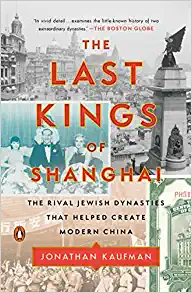
The Last Kings of Shanghai: The Rival Jewish Dynasties That Helped Create Modern China

8,000.00

An epic, multigenerational story of two rival dynasties who flourished in Shanghai and Hong Kong as twentieth-century China surged into the modern era, from the Pulitzer Prize-winning journalist

The Sassoons and the Kadoories stood astride Chinese business and politics for more than one hundred seventy-five years, profiting from the Opium Wars; surviving Japanese occupation; courting Chiang Kai-shek; and nearly losing everything as the Communists swept into power. Jonathan Kaufman tells the remarkable history of how these families ignited an economic boom and opened China to the world, but remained blind to the country’s deep inequality and to the political turmoil on their doorsteps. In a story stretching from Baghdad to Hong Kong to Shanghai to London, Kaufman enters the lives and minds of these ambitious men and women to forge a tale of opium smuggling, family rivalry, political intrigue, and survival.

Christianity: A Global History

8,000.00

David Chidester, one of the world’s foremost scholars of religion, traces Christianity’s growth and development from the time of Jesus to the dawn of the third millennium, revealing its rich diversity through the deeds and beliefs of heretics and saints, witches and healers, preachers and inquisitors. Chidester explores the emergence of the major streams of Christian thought and practice, distilling the cultural history of the Church and its impact on the world into this superbly readable book. Alongside this broad panorama is a richly human story that the author brilliantly encapsulates in incisive character sketches and historical vignettes.

Christianity, in all its many facets, has been and continues to be one of the most influential forces in history. Chidester shows that this religion, with its roots deep in the ancient world, has always been in a constant state of evolution, affecting and affected by the religions and societies around it. At times Christianity has coexisted peacefully with other forms of belief, exchanging ideas and practices with them. At other times profound, even violent, conflict has arisen. In this book David Chidester intelligently and objectively portrays Christians in different times and places, as a minority and as the majority group, a religion both absorbing and resisting the world around it.

Christianity reveals the religion as it was and is lived in the life of everyday people rather than focusing on the dry dogmas and beliefs that fill most histories. Chidester’s accomplishment is to capture the complexity and grand sweep of this story in one remarkable volume that is destined to take its place as a classic of religious history.

The Hour Of Fate

8,000.00

A riveting narrative of Wall Street buccaneering, political intrigue, and two of American history’s most colossal characters, struggling for mastery in an era of social upheaval and rampant inequality.

It seemed like no force in the world could slow J. P. Morgan’s drive to power. In the summer of 1901, the financier was assembling his next mega-deal: Northern Securities, an enterprise that would affirm his dominance in America’s most important industry―the railroads.

Then, a bullet from an anarchist’s gun put an end to the business-friendly presidency of William McKinley. A new chief executive bounded into office: Theodore Roosevelt. He was convinced that as big business got bigger, the government had to check the influence of the wealthiest or the country would inch ever closer to collapse. By March 1902, battle lines were drawn: the government sued Northern Securities for antitrust violations. But as the case ramped up, the coal miners’ union went on strike and the anthracite pits that fueled Morgan’s trains and heated the homes of Roosevelt’s citizens went silent. With millions of dollars on the line, winter bearing down, and revolution in the air, it was a crisis that neither man alone could solve.

Richly detailed and propulsively told, The Hour of Fate is the gripping story of a banker and a president thrown together in the crucible of national emergency even as they fought in court. The outcome of the strike and the case would change the course of our history. Today, as the country again asks whether saving democracy means taming capital, the lessons of Roosevelt and Morgan’s time are more urgent than ever.

The Founding Fortunes

8,000.00

While history teaches that successful revolutions depend on participation by the common man, the establishment of a stable and independent United States first required wealthy colonials uniting to disrupt the very system that had enriched them, and then funding a very long war. While some fortunes were made during the war at the expense of the poor, many of the wealthy embraced the goal of obtaining for their poorer countrymen an unprecedented equality of opportunity, along with independence.

In addition to nuanced views of the well-known wealthy such as Robert Morris and John Hancock, and of the less wealthy but influential Alexander Hamilton, The Founding Fortunes offers insight into the contributions of those often overlooked by popular history: Henry Laurens, the plantation owner who replaced Hancock as President of Congress; pioneering businessmen William Bingham, Jeremiah Wadsworth, and Stephen Girard; privateer magnate Elias Hasket Derby; and Hamilton’s successors at Treasury, Oliver Wolcott, Jr. and Albert Gallatin.

The Founders dealt with tariffs, taxes on the wealthy, the national debt, regional disparities, the census as it affected finances, and how much of what America needs should be manufactured at home in ways that remain startlingly relevant. Revelatory and insightful, The Founding Fortunes provides a riveting history of economic patriotism that still resonates today.

Cleopatra

8,000.00

Our world today would not be the same without Cleopatra. While she is one of the most famous figures in history, the legendary Egyptian queen remains, in many ways, an enigma. In this mesmerizing history, Alberto Angela offers a fresh and dynamic portrait of this extraordinary ruler, revealing a strikingly modern woman born in an ancient era and skilled in the art of diplomacy and war, who would conquer the heart of a general—Marc Antony—and Rome itself.

Cleopatra focuses on a twenty-year period that marked a sweeping change in Roman history, beginning with the assassination of Julius Caesar that led to the end of the Republic, and ending with the suicides of Antony and Cleopatra and the birth of the Augustan Empire. Angela brings the people, stories, customs, and traditions of this fascinating period alive as he transports us to the chaotic streets of the capital of the ancient world, the exotic port of Alexandria in Egypt, and to the bloody battlefields where an empire was won and lost.

Meticulously researched and rich with vivid detail, this sweeping history, reminiscent of the works of Simon Schama, Mary Beard’s SPQR, and Tom Holland’s Rubicon, recreates this remarkable era and the woman at its turbulent center.

1 6 7 8 11