History & Geography

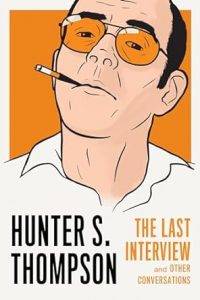
The Last Interview: Hunter Thompson

9,000.00

Hunter S. Thompson was so outside the box, a new word was invented just to define him: Gonzo. He was a journalist who mocked all the rules, a hell-bent fellow who loved to stomp on his own accelerator, the writer every other writer tried to imitate. In these brutally candid and very funny interviews that range across his fabled career, Thompson reveals himself as mad for politics, which he thought was both the source of the country’s despair and, just maybe, the answer to it. At a moment when politics is once again roiling America, we need Thompson’s guts and wild wisdom more than ever.

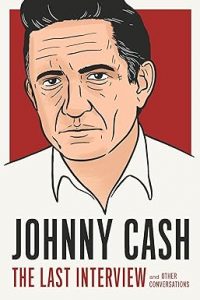
The Last Interview: Johnny Cash

9,000.00

Mythmaker, philosopher, sinner, and saint, Johnny Cash is perhaps the quintessential American icon. Though often rebellious and unruly, he rarely spoke without intention, sincerity, and a bit of poetry. Together with an introduction by music critic Peter Guralnick, the interviews here spotlight that inimitable rhetorical style, and the fascinating diversity of subjects that made him as relatable as he was mysterious.

From a hopped up early interview with Pete Seeger, to a meditation on sobriety, to the last interview in which he stares calmly into the face of death, this collection brings together decades of insight as deeply profound as the unforgettable baritone of The Man in Black himself.

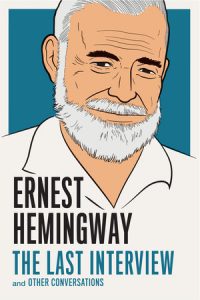
The Last Interview: Ernest Hemingway

9,000.00

Get to know the man behind the legend in this extraordinary collection of interviews with the Nobel Prize–winning author who defined American literature.

Hemingway was not only known for his understated style, but for his public image as America’s greatest author and journalist—and for the grand, expansive, adventurous way he lived his life. The prickly wit and fierce dedication to his craft that defined Hemingway’s life and work shine through in this unprecedented collection of interviews.

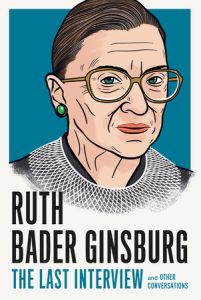
The Last Interview: Ruth Bader Ginsburg

9,000.00

From her start in Depression-era New York, to her final days at the pinnacle of the American legal system, Ruth Bader Ginsburg defied convention, blazing a trail that helped bring greater equality to women, and to all Americans.

In this collection of in-depth interviews — including her last, as well as one of her first — Ginsburg details her rise from a Brooklyn public school to becoming the second woman on the United States Supreme Court, and her non-stop fight for gender equality along the way. Besides telling the story behind many of her famous court battles, she also talks openly about motherhood and her partnership with her beloved husband, her Jewishness, her surprising friendship with her legal polar opposite Justice Antonin Scalia, her passion for opera, and, in one of the collection’s most charming interviews, offers advice to high school students wondering about the law.

It is, in the end, both an engrossing look into a fascinating life, and an inspiring tribute to an American icon.

The Last Interview: John Lewis

9,000.00

Featuring interviews of civil rights activist and congressman John Lewis at almost every stage of his career, this collection illustrates why Lewis has become a human rights icon and remains an inspiration to activists today

Throughout John Lewis’s long and storied career he maintained a seemingly unwavering hope for a better future. This hope can be traced throughout the inteviews collected here. From a young activist testifying in the aftermath of Bloody Sunday to recounting the violence he met as a Freedom Rider to an elder statesman inspired by today’s civil rights activists, this collection forms a portrait of a man whose life was spent fighting for a better world and never lost hope.

Shrinks: The Untold Story Of Psychiatry

9,000.00

Psychiatry has come a long way since the days of chaining “lunatics” in cold cells and parading them as freakish marvels before a gaping public.

But, as Jeffrey Lieberman, MD, the former president of the American Psychiatric Association, reveals in his extraordinary and eye-opening book, the path to legitimacy for “the black sheep of medicine” has been anything but smooth.

In Shrinks, Dr. Lieberman traces the field from its birth as a mystic pseudo-science through its adolescence as a cult of “shrinks” to its late blooming maturity — beginning after World War II — as a science-driven profession that saves lives. With fascinating case studies and portraits of the luminaries of the field — from Sigmund Freud to Eric Kandel — Shrinks is a gripping and illuminating read, and an urgent call-to-arms to dispel the stigma of mental illnesses by treating them as diseases rather than unfortunate states of mind.

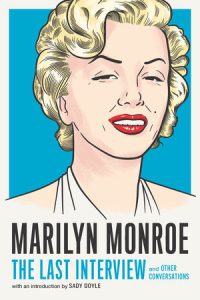
The Last Interview: Marilyn Monroe

9,000.00

Nearly sixty years after her death, Marilyn Monroe remains an icon whom everyone loves but no one really knows. The conversations gathered here–spanning her emergence on the Hollywood scene to just days before her death at age 36–show Monroe at her sharpest and most insightful on the thorny topics of ambition, fame, femininity, desire, and more. Together with an introduction by Sady Doyle, these pieces reveal yet another Marilyn: not the tragic heroine she’s become in the popular imagination, but a righteously and justifiably angry figure breaking free of the limitations the world forced on her.

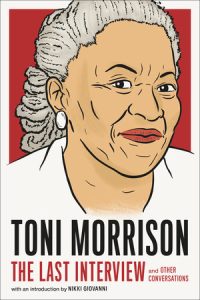
The Last Interview: Toni Morrison

9,000.00

In this wide-ranging collection of thought-provoking interviews — including her first and last — Toni Morrison (whom President Barrack Obama called a “national treasure”) details not only her writing life, but also her other careers as a teacher, and as a publisher, as well as the gripping story of her family.

In fact, Morrison reveals here that her Nobel Prize-winning novels, such as Beloved and Song of Solomon, were born out of her family’s stories — such as those of her great-grandmother, born a slave, or her father, escaping the lynch mobs of the South. With an introduction by her close friend, poet Nikki Giovani, Morrison hereby weaves yet another fascinating and inspiring narrative — that of herself.

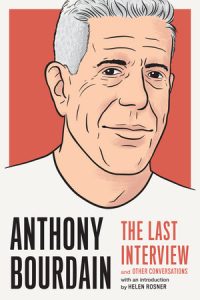
The Last Interview: Anthony Bourdain

9,000.00

The brilliant intellect and candor of Anthony Bourdain is on full display in this collection of interviews from throughout his remarkable career, with an introduction from The New Yorker’s Helen Rosner.

Anthony Bourdain always downplayed his skills as a chef (many disagreed). But despite his modesty, one thing even he agreed with was that he was a born raconteur—as he makes clear in this collection of sparkling conversations. His wit, passion, and deep intelligence shine through all manner of discussion here, from heart-to-hearts with bloggers, to on-stage talks before massive crowds, to intense interviews with major television programs.

Without fail, Bourdain is always blisteringly honest—such as when he talks about his battles with addiction, or when detailing his thoughts on restaurant critics. He regularly dispenses arresting insight about how what’s on your plate reveals much of history and politics. And perhaps best of all, the heartfelt empathy he developed travelling the world for his TV shows is always in the fore, as these talks make the “Hemingway of gastronomy,” as chef Marco Pierre White called him, live again.

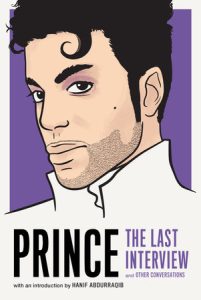
The Last Interview: Prince

9,000.00

A collection of the very first, the very last, and the very best interviews conducted with Prince over his nearly 40 year career.

There is perhaps no musician who has had as much influence on the sound of contemporary American music than Prince. His pioneering compositions brought a variety of musical genres into a singular funky and virtuosic sound. In this remarkable collection, and with his signature mix of seduction and demur, the late visionary reflects on his artistry, identity, and the sacrifices and soul-searching it took to stay true to himself. An Introduction by Hanif Abdurraqib offers astute, contemporary perspective and brilliantly contextualizes the collected interviews.

The Nineties

9,000.00

It was long ago, but not as long as it seems: The Berlin Wall fell and the Twin Towers collapsed. In between, one presidential election was allegedly decided by Ross Perot while another was plausibly decided by Ralph Nader. Landlines fell to cell phones, the internet exploded, and pop culture accelerated without the aid of technology that remembered everything. It was the last era with a real mainstream to either identify with or oppose. The ’90s brought about a revolution in the human condition, and a shift in consciousness, that we’re still struggling to understand. Happily, Chuck Klosterman is more than up to the job.

In The Nineties, Klosterman dissects the film, the music, the sports, the TV, the pre-9/11 politics, the changes regarding race and class and sexuality, the yin/yang of Oprah and Alan Greenspan, and (almost) everything else. The result is a multidimensional masterpiece, a work of synthesis so smart and delightful that future historians might well refer to this entire period as Klostermanian.

The Rebel And The Kingdom

9,000.00

In the early 2000s, Adrian Hong was a soft-spoken Yale undergraduate looking for his place in the world. After reading a harrowing account of life inside North Korea, he realized he had found a cause so pressing that he was ready to devote his life to it.

What began as a trip down the safe and well-worn path of organizing soon morphed into something more dangerous. Hong journeyed to China, outwitting Chinese security services as he helped asylum-seeking North Koreans escape across the border. Meanwhile, Hong’s secret organization, Cheollima Civil Defense (later renamed Free Joseon), began tracking the North Korean government’s activities, and its volatile third-generation ruler, Kim Jong-un. Free Joseon targeted North Korean diplomats who might be persuaded to defect, while drawing up plans for a government-in-exile. After the shocking broad-daylight assassination in 2017 of Kim Jong-nam, the dictator’s older brother, Hong, along with U.S. Marine veteran Christopher Ahn, helped ferry Kim Jong-nam’s family to safety. Then Hong took the group a step further. He initiated a series of high-stakes direct actions, culminating in an armed raid at the North Korean embassy in Madrid—an act that would put Ahn behind bars and turn Hong into one of the world’s most unlikely fugitives.

In the tradition of Jon Krakauer’s Into the Wild, The Rebel and the Kingdom is an exhilarating account of a man who turns his back on the status quo—to instead live boldly by his principles. Acclaimed journalist and bestselling author Bradley Hope—who broke numerous details of Hong’s operations in The Wall Street Journal—now reveals the full contours of this remarkable story of idealism and insanity, hubris and heroism, all set within the secret battle for the future of the world’s most mysterious and unsettling nation.

Rise And Kill First

9,000.00

The Talmud says: “If someone comes to kill you, rise up and kill him first.” This instinct to take every measure, even the most aggressive, to defend the Jewish people is hardwired into Israel’s DNA. From the very beginning of its statehood in 1948, protecting the nation from harm has been the responsibility of its intelligence community and armed services, and there is one weapon in their vast arsenal that they have relied upon to thwart the most serious threats: Targeted assassinations have been used countless times, on enemies large and small, sometimes in response to attacks against the Israeli people and sometimes preemptively.

In this page-turning, eye-opening book, journalist and military analyst Ronen Bergman—praised by David Remnick as “arguably [Israel’s] best investigative reporter”—offers a riveting inside account of the targeted killing programs: their successes, their failures, and the moral and political price exacted on the men and women who approved and carried out the missions.

Bergman has gained the exceedingly rare cooperation of many current and former members of the Israeli government, including Prime Ministers Shimon Peres, Ehud Barak, Ariel Sharon, and Benjamin Netanyahu, as well as high-level figures in the country’s military and intelligence services: the IDF (Israel Defense Forces), the Mossad (the world’s most feared intelligence agency), Caesarea (a “Mossad within the Mossad” that carries out attacks on the highest-value targets), and the Shin Bet (an internal security service that implemented the largest targeted assassination campaign ever, in order to stop what had once appeared to be unstoppable: suicide terrorism).

Including never-before-reported, behind-the-curtain accounts of key operations, and based on hundreds of on-the-record interviews and thousands of files to which Bergman has gotten exclusive access over his decades of reporting, Rise and Kill First brings us deep into the heart of Israel’s most secret activities. Bergman traces, from statehood to the present, the gripping events and thorny ethical questions underlying Israel’s targeted killing campaign, which has shaped the Israeli nation, the Middle East, and the entire world.

The Battle For The Falklands

9,000.00

The Battle for the Falklands is a thoughtful and informed analysis of an astonishing chapter in modern British history from journalist and military historian Sir Max Hastings and political editor Simon Jenkins.

Ten weeks. 28,000 soldiers. 8,000 miles from home.

The Falklands War in 1982 was one of the strangest in British history. At the time, many Britons saw it as a tragic absurdity – thousands of men sent overseas for a tiny relic of empire – but the British victory over the Argentinians not only confirmed the quality of British arms but also boosted the political fortunes of Thatcher’s Conservative government. However, it left a chequered aftermath and was later overshadowed by the two Gulf wars.

Max Hastings’ and Simon Jenkins’ account of the conflict is a modern classic of war reportage and the definitive book on the conflict.

The Key Man

9,000.00

In this compelling story of lies, greed and tarnished idealism, two Wall Street Journal reporters investigate a man who Bill Gates, Western governments, and other investors entrusted with billions of dollars to make profits and end poverty, but who now stands accused of masterminding one of the biggest, most brazen financial frauds ever.

Arif Naqvi was charismatic, inspiring, and self-made—all the qualities of a successful business leader. The founder of Abraaj, a Dubai-based private-equity firm, Naqvi was the Key Man to the global elite searching for impact investments to make money and do good. He persuaded politicians he could help stabilize the Middle East after 9/11 by providing jobs and guided executives to opportunities in cities they struggled to find on the map. Bill Gates helped him start a $1 billion fund to improve healthcare in poor countries and the UN and Interpol appointed him to boards. As Pope Francis blessed a move to harness capitalism for the good of the poor, Naqvi won the support of Obama’s administration and investors, who compared him to Tom Cruise in Mission: Impossible.

In 2018, Simon Clark and Will Louch were contacted by an anonymous whistleblower who said Naqvi had swindled investors out of hundreds of millions of dollars and offered bribes to sustain his billionaire lifestyle. Digging into the claims, Clark and Louch uncovered hundreds of documents and exposed the wrongdoing. In April 2019—months after their exposé broke—Naqvi was arrested on charges of fraud and racketeering, and faces up to 291 years in jail.

Populated by a cast of larger-than-life characters and moving across Asia, Africa, Europe and America, The Key Man is the story of how the global elite was duped by a capitalist fairytale. Clark and Louch shine a light on efforts to clean up global capital flows even as opaque private equity firms amass trillions of dollars and offshore tax havens cast a veil of secrecy which prevents regulators, investors and citizens from understanding what’s really going on in the finance industry.

1 5 6 7 11