










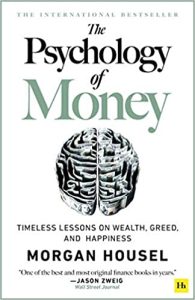
The Psychology Of Money
₦28,000.00Doing well with money isn’t necessarily about what you know. It’s about how you behave. And behavior is hard to teach, even to really smart people.
Money―investing, personal finance, and business decisions―is typically taught as a math-based field, where data and formulas tell us exactly what to do. But in the real world people don’t make financial decisions on a spreadsheet. They make them at the dinner table, or in a meeting room, where personal history, your own unique view of the world, ego, pride, marketing, and odd incentives are scrambled together.
In The Psychology of Money, award-winning author Morgan Housel shares 19 short stories exploring the strange ways people think about money and teaches you how to make better sense of one of life’s most important topics.

Inspired
₦28,000.00Learn to design, build, and scale products consumers can’t get enough of
How do today’s most successful tech companies―Amazon, Google, Facebook, Netflix, Tesla―design, develop, and deploy the products that have earned the love of literally billions of people around the world? Perhaps surprisingly, they do it very differently than most tech companies. In INSPIRED, technology product management thought leader Marty Cagan provides readers with a master class in how to structure and staff a vibrant and successful product organization, and how to discover and deliver technology products that your customers will love―and that will work for your business.
With sections on assembling the right people and skillsets, discovering the right product, embracing an effective yet lightweight process, and creating a strong product culture, readers can take the information they learn and immediately leverage it within their own organizations―dramatically improving their own product efforts.
Whether you’re an early-stage startup working to get to product/market fit, or a growth-stage company working to scale your product organization, or a large, long-established company trying to regain your ability to consistently deliver new value for your customers, INSPIRED will take you and your product organization to a new level of customer engagement, consistent innovation, and business success.
Filled with the author’s own personal stories―and profiles of some of today’s most-successful product managers and technology-powered product companies, including Adobe, Apple, BBC, Google, Microsoft, and Netflix―INSPIRED will show you how to turn up the dial of your own product efforts, creating technology products your customers love.
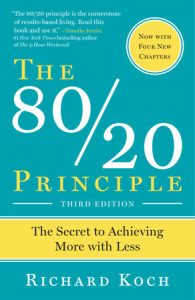
The 80/20 Principle
₦28,000.00The 80/20 principle is one of the great secrets of highly effective people and organizations.
Did you know, for example, that 20 percent of customers account for 80 percent of revenues? That 20 percent of our time accounts for 80 percent of the work we accomplish? The 80/20 Principle shows how we can achieve much more with much less effort, time, and resources, simply by identifying and focusing our efforts on the 20 percent that really counts. Although the 80/20 principle has long influenced today’s business world, author Richard Koch reveals how the principle works and shows how we can use it in a systematic and practical way to vastly increase our effectiveness, and improve our careers and our companies.
The unspoken corollary to the 80/20 principle is that little of what we spend our time on actually counts. But by concentrating on those things that do, we can unlock the enormous potential of the magic 20 percent, and transform our effectiveness in our jobs, our careers, our businesses, and our lives.
How Infrastructure Works
₦28,000.00A new way of seeing the essential systems hidden inside our walls, under our streets, and all around us
Infrastructure is a marvel, meeting our basic needs and enabling lives of astounding ease and productivity that would have been unimaginable just a century ago. It is the physical manifestation of our social contract—of our ability to work collectively for the public good—and it consists of the most complex and vast technological systems ever created by humans.
A soaring bridge is an obvious infrastructural feat, but so are the mostly hidden reservoirs, transformers, sewers, cables, and pipes that deliver water, energy, and information to wherever we need it. When these systems work well, they hide in plain sight. Engineer and materials scientist Deb Chachra takes readers on a fascinating tour of these essential utilities, revealing how they work, what it takes to keep them running, just how much we rely on them—but also whom they work well for, and who pays the costs.
Across the U.S. and elsewhere, these systems are suffering from systemic neglect and the effects of climate change, becoming unavoidably visible when they break down. Communities that are already marginalized often bear the brunt of these failures. But Chachra maps out a path for transforming and rebuilding our shared infrastructure to be not just functional but also equitable, resilient, and sustainable. The cost of not being able to rely on these systems is unthinkably high. We need to learn how to see them—and fix them, together—before it’s too late.