Paperback


₦9,000.00
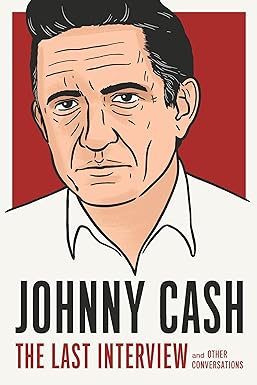
The Last Interview: Johnny Cash
Mythmaker, philosopher, sinner, and saint, Johnny Cash is perhaps the quintessential American icon. Though often rebellious and unruly, he rarely spoke without intention, sincerity, and a bit of poetry. Together with an introduction by music critic Peter Guralnick, the interviews here spotlight that inimitable rhetorical style, and the fascinating diversity of subjects that made him as relatable as he was mysterious.
From a hopped up early interview with Pete Seeger, to a meditation on sobriety, to the last interview in which he stares calmly into the face of death, this collection brings together decades of insight as deeply profound as the unforgettable baritone of The Man in Black himself.
Related products
The Bomb
₦7,000.00Fred Kaplan, hailed by TheNew York Times as “a rare combination of defense intellectual and pugnacious reporter,” takes us into the White House Situation Room, the Joint Chiefs of Staff’s “Tank” in the Pentagon, and the vast chambers of Strategic Command to bring us the untold stories—based on exclusive interviews and previously classified documents—of how America’s presidents and generals have thought about, threatened, broached, and just barely avoided nuclear war from the dawn of the atomic age until today.
Kaplan’s historical research and deep reporting will stand as the permanent record of politics. Discussing theories that have dominated nightmare scenarios from Hiroshima and Nagasaki, Kaplan presents the unthinkable in terms of mass destruction and demonstrates how the nuclear war reality will not go away, regardless of the dire consequences.
Sankara
₦2,500.00The African Renaissance is the concept that African people and nations shall overcome the current challenges confronting the continent and achieve cultural, scientific, and economic renewal.
At thirty-three, in 1983, Thomas Sankara came to power with a goal of eliminating corruption and eliminating the vestiges colonial domination. He immediately launched one of the most ambitious programmes for social and economic change ever attempted on the African continent. Sankara was assassinated by troops led by Blaise Compaoré in 1987.
It is this Thomas Sankara, held by some as one of Africa’s foremost statesmen, and derided by a small minority as a ruthless dictator, that Jude Idada sets to examine in this play. Everyone interested in history and the subject of an African Renaissance should read this play written by Jude Idada
Strongmen
₦8,500.00Ruth Ben-Ghiat is the expert on the “strongman” playbook employed by authoritarian demagogues from Mussolini to Putin—enabling her to predict with uncanny accuracy the recent experience in America and Europe. In Strongmen, she lays bare the blueprint these leaders have followed over the past 100 years, and empowers us to recognize, resist, and prevent their disastrous rule in the future.
For ours is the age of authoritarian rulers: self-proclaimed saviors of the nation who evade accountability while robbing their people of truth, treasure, and the protections of democracy. They promise law and order, then legitimize lawbreaking by financial, sexual, and other predators.
They use masculinity as a symbol of strength and a political weapon. Taking what you want, and getting away with it, becomes proof of male authority. They use propaganda, corruption, and violence to stay in power.
Vladimir Putin and Mobutu Sese Seko’s kleptocracies, Augusto Pinochet’s torture sites, Benito Mussolini and Muammar Gaddafi’s systems of sexual exploitation, and Silvio Berlusconi and Donald Trump’s relentless misinformation: all show how authoritarian rule, far from ensuring stability, is marked by destructive chaos.
No other type of leader is so transparent about prioritizing self-interest over the public good. As one country after another has discovered, the strongman is at his worst when true guidance is most needed by his country.
Recounting the acts of solidarity and dignity that have undone strongmen over the past 100 years, Ben-Ghiat makes vividly clear that only by seeing the strongman for what he is—and by valuing one another as he is unable to do—can we stop him, now and in the future.
The Ogoni of the Eastern Niger Delta
₦8,000.00The Ogoni of the Eastern Niger Delta are an ancient African community in Southern Nigeria, whose history dates back to BC times. Their history is rich in customs, traditions, economics, politics and culture, which date back to Herodotus, the Greek historian, who wrote about the Silent Trade in West Africa”, in the 4th century BC, a story also reported by the Ogoni in their oral tradition.
Scholars frequently relate the history of West Africa to the coming of the white man into the region. The Ogoni of the Eastern Niger Delta shows that the colonialists later came to see a lot of innovations by the Ogoni; such as trade, money, industry, agriculture, leadership training, government, law, music, sea travel, war and more.
This book is a giant attempt to record and preserve these cultures for future study and development. There is a seperate volume containing fieldwork data on almost every subject for researchers to consult.
Beneath the Tamarind Tree
₦5,000.00In the early morning of April 14, 2014, the militant Islamic group Boko Haram violently burst into the small town of Chibok, Nigeria, and abducted 276 girls from their school dorm rooms. From poor families, these girls were determined to make better lives for themselves, but pursuing an education made them targets, resulting in one of the most high-profile abductions in modern history. While the Chibok kidnapping made international headlines, and prompted the #BringBackOurGirls movement, many unanswered questions surrounding that fateful night remain about the girls’ experiences in captivity, and where many of them are today.
In Beneath the Tamarind Tree, Isha Sesay tells this story as no one else can. Originally from Sierra Leone, Sesay led CNN’s Africa reporting for more than a decade, and she was on the front lines when this story broke. With unprecedented access to a group of girls who made it home, she follows the journeys of Priscilla, Saa, and Dorcas in an uplifting tale of sisterhood and survival.
Sesay delves into the Nigerian government’s inadequate response to the kidnapping, exposes the hierarchy of how the news gets covered, and synthesizes crucial lessons about global national security. She also reminds us of the personal sacrifice required of journalists to bring us the truth at a time of growing mistrust of the media. Beneath the Tamarind Tree is a gripping read and a story of resilience with a soaring message of hope at its core, reminding us of the ever-present truth that progress for all of us hinges on unleashing the potential of women.
Reviews
There are no reviews yet.