Hardcover


₦14,000.00
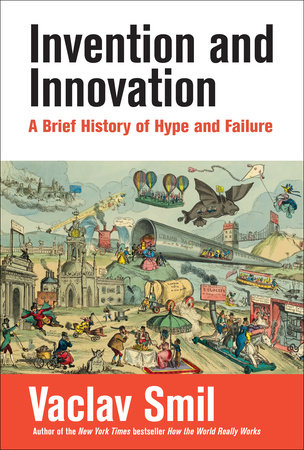
Invention and Innovation
From the New York Times-bestselling author, a new volume on the history of human ingenuity—and its attendant breakthroughs and busts.
The world is never finished catching up with Vaclav Smil. In his latest and perhaps most readable book, Invention and Innovation, the prolific author—a favorite of Bill Gates—pens an insightful and fact-filled jaunt through the history of human invention. Impatient with the hype that so often accompanies innovation, Smil offers in this book a clear-eyed corrective to the overpromises that accompany everything from new cures for diseases to AI. He reminds us that even after we go quite far along the invention-development-application trajectory, we may never get anything real to deploy. Or worse, even after we have succeeded by introducing an invention, its future may be marked by underperformance, disappointment, demise, or outright harm.
Drawing on his vast breadth of scientific and historical knowledge, Smil explains the difference between invention and innovation. He then looks at three different types of inventions
Related products
Private Island
₦4,500.00In a little over a generation the bones and sinews of the British economy – rail, energy, water, postal services, municipal housing – have been sold to remote, unaccountable private owners, often from overseas. In a series of brilliant portraits the award-winning novelist and journalist James Meek shows how Britain’s common wealth became private, and the impact it has had on us all: from the growing shortage of housing to spiralling energy bills.
Meek explores the human stories behind the incremental privatization of the nation over the last three decades. He shows how, as our national assets are sold, ordinary citizens are handed over to private tax-gatherers, and the greatest burden of taxes shifts to the poorest. In the end, it is not only public enterprises that have become private property, but we ourselves.
Urgent, powerfully written and deeply moving, this is a passionate anatomy of the state of the nation: of what we have lost and what losing it cost us – the rent we must pay to exist on this private island.
Forged In Crisis
₦6,000.00An enthralling historical narrative filled with critical leadership insights, Forged in Crisis, by celebrated Harvard Business School historian Nancy Koehn, spotlights five masters of crisis: polar explorer Ernest Shackleton; President Abraham Lincoln; legendary abolitionist Frederick Douglass; Nazi-resisting clergyman Dietrich Bonhoeffer; and environmental crusader Rachel Carson.
What do such disparate figures have in common? Why do their extraordinary stories continue to amaze and inspire? In delivering the answers to those questions, Nancy Koehn offers a remarkable template by which to judge those in our own time to whom the public has given its trust.
She begins each of the book’s five sections by showing her protagonist on the precipice of a great crisis: Shackleton marooned on an Antarctic ice floe; Lincoln on the verge of seeing the Union collapse; escaped slave Douglass facing possible capture; Bonhoeffer agonizing over how to counter absolute evil with faith; Carson racing against the cancer ravaging her in a bid to save the planet. The narrative then reaches back to each person’s childhood and shows the individual growing—step by step—into the person he or she will ultimately become. Significantly, as we follow each leader’s against-all-odds journey, we begin to glean an essential truth: leaders are not born but made. In a book dense with epiphanies, the most galvanizing one may be that the power to lead courageously resides in each of us.
Whether it’s read as a repository of great insight or as exceptionally rendered human drama, Forged in Crisis stands as a towering achievement.
What Britain Did To Nigeria
₦9,000.00Most accounts of Nigeria’s colonisation were written by British officials, presenting it as a noble civilising mission to rid Africans of barbaric superstition and corrupt tribal leadership. Thanks to this skewed writing of history, many Nigerians today still have Empire nostalgia and view the
colonial period through rose-tinted glasses.
Max Siollun offers a bold rethink: an unromanticised history, arguing compellingly that colonialism had few benevolent intentions, but many unjust outcomes. It may have ended slavery and human sacrifice, but it was accompanied by extreme violence; ethnic and religious identity were cynically exploited to maintain control, while the forceful remoulding of longstanding legal and social practices permanently altered the culture and internal politics of indigenous communities. The aftershocks of this colonial meddling are still being felt decades after independence. Popular narratives often suggest that the economic and political turmoil are homegrown, but the reality is that Britain created many of Nigeria’s crises, and has left them behind for Nigerians to resolve.
This is a definitive, head-on confrontation with Nigeria’s experience under British rule, showing how it forever changed the country–perhaps cataclysmically.
The Bomb
₦7,000.00Fred Kaplan, hailed by TheNew York Times as “a rare combination of defense intellectual and pugnacious reporter,” takes us into the White House Situation Room, the Joint Chiefs of Staff’s “Tank” in the Pentagon, and the vast chambers of Strategic Command to bring us the untold stories—based on exclusive interviews and previously classified documents—of how America’s presidents and generals have thought about, threatened, broached, and just barely avoided nuclear war from the dawn of the atomic age until today.
Kaplan’s historical research and deep reporting will stand as the permanent record of politics. Discussing theories that have dominated nightmare scenarios from Hiroshima and Nagasaki, Kaplan presents the unthinkable in terms of mass destruction and demonstrates how the nuclear war reality will not go away, regardless of the dire consequences.
American Sketches
₦5,000.00One of America’s most versatile writers, author of bestselling biographies such as Steve Jobs and Benjamin Franklin, has assembled a gallery of portraits of (mostly) Americans that celebreate genius, talent, and versatility, and traces his own education as a writer and biographer.
In this collection of essays, the brilliant, acclaimed biographer Walter Isaacson reflects on lessons to be learned from Benjamin Franklin, Albert Einstein, Bill Gates, Henry Kissinger, Ronald Reagan and Mikhail Gorbachev, Hillary Clinton and Bill Clinton, and other interesting characters he has chronicled both as biographer and journalist. The people he writes about have an awesome intelligence, but that is not the secret to their success. They had qualities that were even more rare, such as imagination and true curiousity.
Isaacson also reflects on how he became a writer, the lessons he learned from various people he met, and the challenges for journalism in the digital age.
He also offers loving tributes to his hometown of New Orleans, which offers many of the ingredients for a creative culture, and to the Louisiana novelist Walker Percy, who was an early mentor. In an anecdotal and personal way, Isaacson describes the joys of writing and the way that tales about the lives of fascinating people can enlighten our own lives.
Reviews
There are no reviews yet.