Hardcover


₦13,000.00
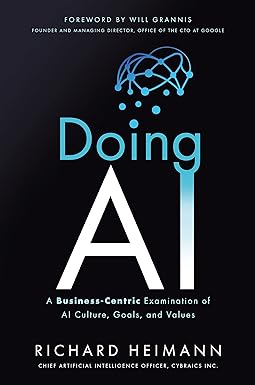
Doing AI
When businesses try to “do AI,” they place an abstract solution before problems and customers without fully considering whether it is wise, whether the hype is true, or how AI will impact their organization in the long term. Often absent is sound reasoning for why they should go down this path in the first place.
Doing AI explores AI for what it actually is—and what it is not— and the problems it can truly solve. In these pages, author Richard Heimann unravels the tricky relationship between problems and high-tech solutions, exploring the pitfalls in solution-centric thinking and explaining how businesses should rethink AI in a way that aligns with their cultures, goals, and values.
As the Chief AI Officer at Cybraics Inc., Richard Heimann knows from experience that AI-specific strategies are often bad for business. Doing AI is his comprehensive guide that will help readers understand AI, avoid common pitfalls, and identify beneficial applications for their companies.
This book is a must-read for anyone looking for clarity and practical guidance for identifying problems and effectively solving them, rather than getting sidetracked by a shiny new “solution” that doesn’t solve anything.
Out of stock
Related products
Think and Grow Rich
₦4,500.00Think and Grow Rich has been called the “Granddaddy of All Motivational Literature.” It was the first book to boldly ask, “What makes a winner?” The man who asked and listened for the answer, Napoleon Hill, is now counted in the top ranks of the world’s winners himself.
The most famous of all teachers of success spent “a fortune and the better part of a lifetime of effort” to produce the “Law of Success” philosophy that forms the basis of his books and that is so powerfully summarized in this one.
In the original Think and Grow Rich, published in 1937, Hill draws on stories of Andrew Carnegie, Thomas Edison, Henry Ford, and other millionaires of his generation to illustrate his principles. In the updated version, Arthur R. Pell, Ph.D., a nationally known author, lecturer, and consultant in human resources management and an expert in applying Hill’s thought, deftly interweaves anecdotes of how contemporary millionaires and billionaires, such as Bill Gates, Mary Kay Ash, Dave Thomas, and Sir John Templeton, achieved their wealth. Outmoded or arcane terminology and examples are faithfully refreshed to preclude any stumbling blocks to a new generation of readers.
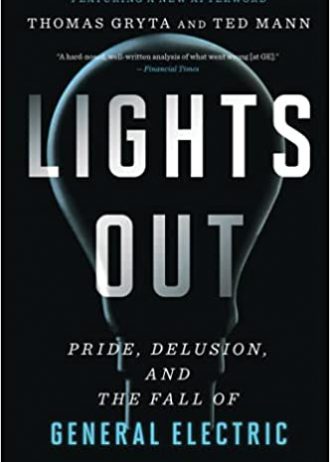
Lights Out
₦10,000.00This is the definitive history of General Electric’s epic decline, as told by the two Wall Street Journal reporters who covered its fall.
Since its founding in 1892, GE has been more than just a corporation. For generations, it was job security, a solidly safe investment, and an elite business education for top managers.
GE electrified America, powering everything from lightbulbs to turbines, and became fully integrated into the American societal mindset as few companies ever had. And after two decades of leadership under legendary CEO Jack Welch, GE entered the twenty-first century as America’s most valuable corporation. Yet, fewer than two decades later, the GE of old was gone.
Lights Out examines how Welch’s handpicked successor, Jeff Immelt, tried to fix flaws in Welch’s profit machine, while stumbling headlong into mistakes of his own. In the end, GE’s traditional win-at-all-costs driven culture seemed to lose its direction, which ultimately caused the company’s decline on both a personal and organizational scale. Lights Out details how one of America’s all-time great companies has been reduced to a cautionary tale for our times.
Extreme Ownership
₦7,500.00An updated edition of the blockbuster bestselling leadership book that took America and the world by storm, two U.S. Navy SEAL officers who led the most highly decorated special operations unit of the Iraq War demonstrate how to apply powerful leadership principles from the battlefield to business and life. Now with an excerpt from the authors’ new book, THE DICHOTOMY OF LEADERSHIP.
Combat, the most intense and dynamic environment imaginable, teaches the toughest leadership lessons, with absolutely everything at stake. Jocko Willink and Leif Babin learned this reality first-hand on the most violent and dangerous battlefield in Iraq. As leaders of SEAL Team Three’s Task Unit Bruiser, their mission was one many thought impossible: help U.S. forces secure Ramadi, a violent, insurgent-held city deemed “all but lost.” In gripping, firsthand accounts of heroism, tragic loss, and hard-won victories, they learned that leadership―at every level―is the most important factor in whether a team succeeds or fails.
Willink and Babin returned home from deployment and instituted SEAL leadership training to pass on their harsh lessons learned in combat to help forge the next generation of SEAL leaders. After leaving the SEAL Teams, they launched a company, Echelon Front, to teach those same leadership principles to leaders in businesses, companies, and organizations across the civilian sector. Since that time, they have trained countless leaders and worked with hundreds of companies in virtually every industry across the U.S. and internationally, teaching them how to develop their own high-performance teams and most effectively lead those teams to dominate their battlefields.
Love is Just Damn Good Business: Do What You Love in the Service of the People Who Love What You Do
₦12,500.00It’s time to toss aside the touchy-feely notions of love in business and acknowledge the real power that it holds. Love is not only appropriate in the context of business, it’s the foundation of great leadership. To put it bluntly: love is just damn good business. That’s the simple but profound truth that leadership consultant Steve Farber has discovered in his extensive work with Fortune 100 companies and other successful businesses. His game-changing approach to love as a practical business strategy will help you to:
• Identify your passions―and share them with others
• Create a culture of love at work―and spark innovation, productivity, and joy
• Serve your customers, so they love how you treat them―and have them coming back for more
• Invest time in making personal connections―that are mutually rewarding
• Focus on serving the needs of others―they’re going to love it
• Do what you love―and make it your business, so others love it, too
The proven principles you’ll find in this book will help you lay the groundwork for a thriving, competitive enterprise. When love is part of your organization’s framework and operationalized in its culture, employees and customers feel genuinely valued. Employees who are passionate about the work that they do are more loyal, innovative, creative, and inspired, and that translates to great customer experience. They don’t serve others out of obligation, but because of a genuine desire to improve people’s lives. And when customers reciprocate by loving your products, your services, and your people, that’s when something great happens. That’s when you get loyalty. That’s when you get raving fans. It’s a refreshingly human way of doing business.
In addition to Farber’s field-tested strategies, you’ll find inspiring case studies from a wide range of industries and leaders, revealing self-assessment quizzes, and practical pointers on how to build a corporate culture based on love, the ultimate competitive advantage. At the end of the day, it’s just damn good business.
The Man Who Knew
₦8,000.00Greenspan’s life is a quintessential American success story: raised by a single mother in the Jewish émigré community of Washington Heights, he was a math prodigy who found a niche as a stats-crunching consultant. A master at explaining the economic weather to captains of industry, he translated that skill into advising Richard Nixon in his 1968 campaign. This led to a perch on the White House Council of Economic Advisers, and then to a dazzling array of business and government roles, from which the path to the Fed was relatively clear. A fire-breathing libertarian and disciple of Ayn Rand in his youth who once called the Fed’s creation a historic mistake, Mallaby shows how Greenspan reinvented himself as a pragmatist once in power. In his analysis, and in his core mission of keeping inflation in check, he was a maestro indeed, and hailed as such. At his retirement in 2006, he was lauded as the age’s necessary man, the veritable God in the machine, the global economy’s avatar. His memoirs sold for record sums to publishers around the world.
But then came 2008. Mallaby’s story lands with both feet on the great crash which did so much to damage Alan Greenspan’s reputation. Mallaby argues that the conventional wisdom is off base: Greenspan wasn’t a naïve ideologue who believed greater regulation was unnecessary. He had pressed for greater regulation of some key areas of finance over the years, and had gotten nowhere. To argue that he didn’t know the risks in irrational markets is to miss the point. He knew more than almost anyone; the question is why he didn’t act, and whether anyone else could or would have. A close reading of Greenspan’s life provides fascinating answers to these questions, answers whose lessons we would do well to heed. Because perhaps Mallaby’s greatest lesson is that economic statesmanship, like political statesmanship, is the art of the possible. The Man Who Knew is a searching reckoning with what exactly comprised the art, and the possible, in the career of Alan Greenspan.
Reviews
There are no reviews yet.