Hardcover


₦35,000.00
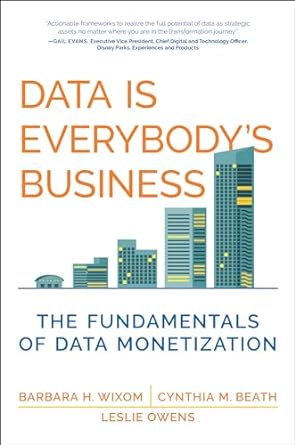
Data Is Everybody’s Business
A clear, engaging, evidence-based guide to monetizing data, for everyone from employee to board member.
Most organizations view data monetization—converting data into money—too narrowly: as merely selling data sets. But data monetization is a core business activity for both commercial and noncommercial organizations, and, within organizations, it’s critical to have wide-ranging support for this pursuit. In Data Is Everybody’s Business, the authors offer a clear and engaging way for people across the entire organization to understand data monetization and make it happen. The authors identify three viable ways to convert data into money—improving work with data, wrapping products with data, and selling information offerings—and explain when to pursue each and how to succeed.
Key features of the book:
• Grounded in twenty-eight years of academic research,including nine years of research at the MIT Sloan Center for Information Systems Research (MIT CISR)
• Definitions of key terms, self-reflection questions, appealing graphics, and easy-to-use frameworks
• Rich with detailed case studies
• Supplemented by free MIT CISR website resources (cisr.mit.edu)
Ideal for organizations engaged in data literacy training, data-driven transformation, or digital transformation, Data Is Everybody’s Business is the essential guide for helping everybody in the organization—not just the data specialists—understand, get excited about, and participate in data monetization.
Out of stock
Related products
Up All Night: Ted Turner, CNN, and the Birth of 24-Hour News
₦7,500.00The wild inside story of the birth of CNN and dawn of the age of 24-hour news
How did we get from an age of dignified nightly news broadcasts on three national networks to the age of 24-hour news channels and constantly breaking news? The answer—thanks to Ted Turner and an oddball cast of cable television visionaries, big league rejects, and nonunion newbies—can be found in the basement of an abandoned country club in Atlanta. Because it was there, in the summer of 1980, that this motley crew launched CNN.
Lisa Napoli’s Up All Night is an entertaining inside look at the founding of the upstart network that set out to change the way news was delivered and consumed, and succeeded beyond even the wildest imaginings of its charismatic and uncontrollable founder. Mixing media history, a business adventure story, and great characters, this is a fun book on the making of the world we live in now.
The Cartiers
₦13,000.00The Cartiers is the revealing tale of a jewelry dynasty—four generations, from revolutionary France to the 1970s. At its heart are the three Cartier brothers whose motto was “Never copy, only create” and who made their family firm internationally famous in the early days of the twentieth century, thanks to their unique and complementary talents: Louis, the visionary designer who created the first men’s wristwatch to help an aviator friend tell the time without taking his hands off the controls of his flying machine; Pierre, the master dealmaker who bought the New York headquarters on Fifth Avenue for a double-stranded natural pearl necklace; and Jacques, the globe-trotting gemstone expert whose travels to India gave Cartier access to the world’s best rubies, emeralds, and sapphires, inspiring the celebrated Tutti Frutti jewelry.
Francesca Cartier Brickell, whose great-grandfather was the youngest of the brothers, has traveled the world researching her family’s history, tracking down those connected with her ancestors and discovering long-lost pieces of the puzzle along the way. Now she reveals never-before-told dramas, romances, intrigues, betrayals, and more.
The Cartiers also offers a behind-the-scenes look at the firm’s most iconic jewelry—the notoriously cursed Hope Diamond, the Romanov emeralds, the classic panther pieces—and the long line of stars from the worlds of fashion, film, and royalty who wore them, from Indian maharajas and Russian grand duchesses to Wallis Simpson, Coco Chanel, and Elizabeth Taylor.
The Ride of a Lifetime
₦15,000.00Robert Iger became CEO of The Walt Disney Company in 2005, during a difficult time. Competition was more intense than ever and technology was changing faster than at any time in the company’s history. His vision came down to three clear ideas: Recommit to the concept that quality matters, embrace technology instead of fighting it, and think bigger—think global—and turn Disney into a stronger brand in international markets.
Today, Disney is the largest, most admired media company in the world, counting Pixar, Marvel, Lucasfilm, and 21st Century Fox among its properties. Its value is nearly five times what it was when Iger took over, and he is recognized as one of the most innovative and successful CEOs of our era.
In The Ride of a Lifetime, Robert Iger shares the lessons he learned while running Disney and leading its 220,000-plus employees, and he explores the principles that are necessary for true leadership, including:
• Optimism. Even in the face of difficulty, an optimistic leader will find the path toward the best possible outcome and focus on that, rather than give in to pessimism and blaming.
• Courage. Leaders have to be willing to take risks and place big bets. Fear of failure destroys creativity.
• Decisiveness. All decisions, no matter how difficult, can be made on a timely basis. Indecisiveness is both wasteful and destructive to morale.
• Fairness. Treat people decently, with empathy, and be accessible to them.
This book is about the relentless curiosity that has driven Iger for forty-five years, since the day he started as the lowliest studio grunt at ABC. It’s also about thoughtfulness and respect, and a decency-over-dollars approach that has become the bedrock of every project and partnership Iger pursues, from a deep friendship with Steve Jobs in his final years to an abiding love of the Star Wars mythology.
The Man Who Knew
₦8,000.00Greenspan’s life is a quintessential American success story: raised by a single mother in the Jewish émigré community of Washington Heights, he was a math prodigy who found a niche as a stats-crunching consultant. A master at explaining the economic weather to captains of industry, he translated that skill into advising Richard Nixon in his 1968 campaign. This led to a perch on the White House Council of Economic Advisers, and then to a dazzling array of business and government roles, from which the path to the Fed was relatively clear. A fire-breathing libertarian and disciple of Ayn Rand in his youth who once called the Fed’s creation a historic mistake, Mallaby shows how Greenspan reinvented himself as a pragmatist once in power. In his analysis, and in his core mission of keeping inflation in check, he was a maestro indeed, and hailed as such. At his retirement in 2006, he was lauded as the age’s necessary man, the veritable God in the machine, the global economy’s avatar. His memoirs sold for record sums to publishers around the world.
But then came 2008. Mallaby’s story lands with both feet on the great crash which did so much to damage Alan Greenspan’s reputation. Mallaby argues that the conventional wisdom is off base: Greenspan wasn’t a naïve ideologue who believed greater regulation was unnecessary. He had pressed for greater regulation of some key areas of finance over the years, and had gotten nowhere. To argue that he didn’t know the risks in irrational markets is to miss the point. He knew more than almost anyone; the question is why he didn’t act, and whether anyone else could or would have. A close reading of Greenspan’s life provides fascinating answers to these questions, answers whose lessons we would do well to heed. Because perhaps Mallaby’s greatest lesson is that economic statesmanship, like political statesmanship, is the art of the possible. The Man Who Knew is a searching reckoning with what exactly comprised the art, and the possible, in the career of Alan Greenspan.
3 Kings: Diddy, Dr Dre, Jay Z, and Hip-Hop’s Multibillion Dollar Rise
₦4,500.00Being successful musicians was simply never enough for the three kings of hip-hop. Diddy, Dr. Dre, and Jay-Z lifted themselves from childhood adversity into tycoon territory, amassing levels of fame and wealth that not only outshone all other contemporary hip-hop artists, but with a combined net worth of well over $2 billion made them the three richest American musicians, period.
Yet their fortunes have little to do with selling their own albums: between Diddy’s Ciroc vodka, Dre’s $3 billion sale of his Beats headphones to Apple, and Jay-Z’s Tidal streaming service and other assets, these artists have transcended pop music fame to become lifestyle icons and moguls.
Hip-hop is no longer just a musical genre; it’s become a way of life that encompasses fashion, film, food, drink, sports, electronics and more — one that has opened new paths to profit and to critical and commercial acclaim. Thanks in large part to the Three Kings — who all started their own record labels and released classic albums before moving on to become multifaceted businessmen — hip-hop has been transformed from a genre spawned in poverty into a truly global multibillion-dollar industry.
These men are the modern embodiment of the American Dream, but their stories as great thinkers and entrepreneurs have yet to be told in full. Based on a decade of reporting, and interviews with more than 100 sources including hip-hop pioneers Russell Simmons and Fab 5 Freddy; new-breed executives like former Def Jam chief Kevin Liles and venture capitalist Troy Carter; and stars from Swizz Beatz to Shaquille O’Neal, 3 Kings tells the fascinating story of the rise and rise of the three most influential musicians in America.
Reviews
There are no reviews yet.