
Paperback

₦10,000.00
Black Ghosts
China today is both a land of opportunity for Africans blocked from commerce with most of Europe and Northern America, and an intersection of racism and prejudice.
Noo Saro-Wiwa goes in search of China’s ‘Black Ghosts’, African economic migrants in the People’s Republic, who live in clustered communities and are involved in the small-commodity trade between the continents. Her fascinating encounters include a cardiac surgeon, a drug dealer, a visa overstayer and men married to Chinese women who speak English with Nigerian accents.
Related products

Ogun State – The Gateway State
₦16,000.00Discover the sights that endear Ogun State to every visitor…another masterpiece from the stable of ‘dayo Adedayo. “Ogun State: A virtual portrait” is an unmissable addition to your collection of narratives on nature and Nigeria from a trusted source.
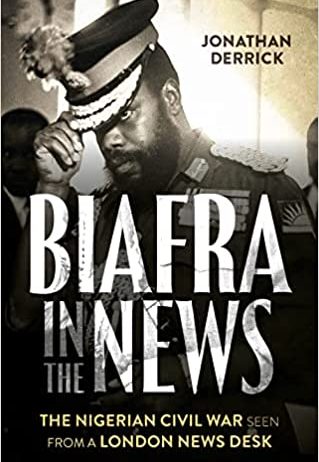
Biafra In The News
₦10,000.00Fifty years ago, Nigeria endured a period of violent disturbance leading to the breakaway of the Eastern Region under the name Biafra. The resulting conflict (1967-70) aroused shock and protests around the world because of mass starvation in the war zone. While Britain supplied arms to the federal
Nigerian government, and France to the Biafrans, relief agencies with contributions from countless individuals organized a memorable airlift of food and medicine to the Biafrans’ Uli airstrip.
Jonathan Derrick, then a journalist for the London weekly West Africa, followed these events closely and
recorded the war in the magazine’s news pages, right up to the federal forces’ final victory and the remarkable reconciliation between supporters of Biafra–predominantly Igbo–and other Nigerians. He later worked for some years in Nigeria, and has studied much of the material published on the war
since 1970.
Here, he recounts the history of the conflict as documented in West Africa, referring to later literature on and analysis of the events, which inspired passion at the time and have provoked debate ever since. His account deals with myths, misapprehensions and controversies surrounding the conflict, while recalling the tragic facts of a grim episode in African history.

The Key Man
₦9,000.00In this compelling story of lies, greed and tarnished idealism, two Wall Street Journal reporters investigate a man who Bill Gates, Western governments, and other investors entrusted with billions of dollars to make profits and end poverty, but who now stands accused of masterminding one of the biggest, most brazen financial frauds ever.
Arif Naqvi was charismatic, inspiring, and self-made—all the qualities of a successful business leader. The founder of Abraaj, a Dubai-based private-equity firm, Naqvi was the Key Man to the global elite searching for impact investments to make money and do good. He persuaded politicians he could help stabilize the Middle East after 9/11 by providing jobs and guided executives to opportunities in cities they struggled to find on the map. Bill Gates helped him start a $1 billion fund to improve healthcare in poor countries and the UN and Interpol appointed him to boards. As Pope Francis blessed a move to harness capitalism for the good of the poor, Naqvi won the support of Obama’s administration and investors, who compared him to Tom Cruise in Mission: Impossible.
In 2018, Simon Clark and Will Louch were contacted by an anonymous whistleblower who said Naqvi had swindled investors out of hundreds of millions of dollars and offered bribes to sustain his billionaire lifestyle. Digging into the claims, Clark and Louch uncovered hundreds of documents and exposed the wrongdoing. In April 2019—months after their exposé broke—Naqvi was arrested on charges of fraud and racketeering, and faces up to 291 years in jail.
Populated by a cast of larger-than-life characters and moving across Asia, Africa, Europe and America, The Key Man is the story of how the global elite was duped by a capitalist fairytale. Clark and Louch shine a light on efforts to clean up global capital flows even as opaque private equity firms amass trillions of dollars and offshore tax havens cast a veil of secrecy which prevents regulators, investors and citizens from understanding what’s really going on in the finance industry.
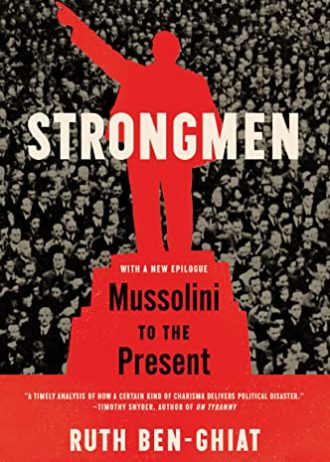
Strongmen
₦8,500.00Ruth Ben-Ghiat is the expert on the “strongman” playbook employed by authoritarian demagogues from Mussolini to Putin—enabling her to predict with uncanny accuracy the recent experience in America and Europe. In Strongmen, she lays bare the blueprint these leaders have followed over the past 100 years, and empowers us to recognize, resist, and prevent their disastrous rule in the future.
For ours is the age of authoritarian rulers: self-proclaimed saviors of the nation who evade accountability while robbing their people of truth, treasure, and the protections of democracy. They promise law and order, then legitimize lawbreaking by financial, sexual, and other predators.
They use masculinity as a symbol of strength and a political weapon. Taking what you want, and getting away with it, becomes proof of male authority. They use propaganda, corruption, and violence to stay in power.
Vladimir Putin and Mobutu Sese Seko’s kleptocracies, Augusto Pinochet’s torture sites, Benito Mussolini and Muammar Gaddafi’s systems of sexual exploitation, and Silvio Berlusconi and Donald Trump’s relentless misinformation: all show how authoritarian rule, far from ensuring stability, is marked by destructive chaos.
No other type of leader is so transparent about prioritizing self-interest over the public good. As one country after another has discovered, the strongman is at his worst when true guidance is most needed by his country.
Recounting the acts of solidarity and dignity that have undone strongmen over the past 100 years, Ben-Ghiat makes vividly clear that only by seeing the strongman for what he is—and by valuing one another as he is unable to do—can we stop him, now and in the future.
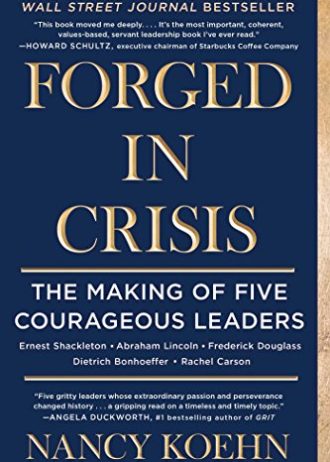
Forged In Crisis
₦6,000.00An enthralling historical narrative filled with critical leadership insights, Forged in Crisis, by celebrated Harvard Business School historian Nancy Koehn, spotlights five masters of crisis: polar explorer Ernest Shackleton; President Abraham Lincoln; legendary abolitionist Frederick Douglass; Nazi-resisting clergyman Dietrich Bonhoeffer; and environmental crusader Rachel Carson.
What do such disparate figures have in common? Why do their extraordinary stories continue to amaze and inspire? In delivering the answers to those questions, Nancy Koehn offers a remarkable template by which to judge those in our own time to whom the public has given its trust.
She begins each of the book’s five sections by showing her protagonist on the precipice of a great crisis: Shackleton marooned on an Antarctic ice floe; Lincoln on the verge of seeing the Union collapse; escaped slave Douglass facing possible capture; Bonhoeffer agonizing over how to counter absolute evil with faith; Carson racing against the cancer ravaging her in a bid to save the planet. The narrative then reaches back to each person’s childhood and shows the individual growing—step by step—into the person he or she will ultimately become. Significantly, as we follow each leader’s against-all-odds journey, we begin to glean an essential truth: leaders are not born but made. In a book dense with epiphanies, the most galvanizing one may be that the power to lead courageously resides in each of us.
Whether it’s read as a repository of great insight or as exceptionally rendered human drama, Forged in Crisis stands as a towering achievement.
Reviews
There are no reviews yet.