History & Geography

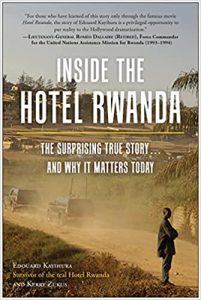
Inside The Hotel Rwanda

6,000.00

In 2004, the Academy Award–nominated movie Hotel Rwanda lionized hotel manager Paul Rusesabagina for single-handedly saving the lives of all who sought refuge in the Hotel des Milles Collines during Rwanda’s genocide against the Tutsi in 1994. Because of the film, the real-life Rusesabagina has been compared to Oskar Schindler, but unbeknownst to the public, the hotel’s refugees don’t endorse Rusesabagina’s version of the events.

In the wake of Hotel Rwanda’s international success, Rusesabagina is one of the most well-known Rwandans and now the smiling face of the very Hutu Power groups who drove the genocide. He is accused by the Rwandan prosecutor general of being a genocide negationist and funding the terrorist group Democratic Forces for the Liberation of Rwanda (FDLR).

In Inside the Hotel Rwanda, survivor Edouard Kayihura tells his own personal story of what life was really like during those harrowing 100 days within the walls of that infamous hotel and offers the testimonies of others who survived there, from Hutu and Tutsi to UN peacekeepers. Kayihura tells of his life in a divided society and his journey to the place he believed would be safe from slaughter.

Inside the Hotel Rwanda exposes Paul Rusesabagina as a profiteering, politically ambitious Hutu Power sympathizer who extorted money from those who sought refuge, threatening to send those who did not pay to the genocidaires, despite pleas from the hotel’s corporate ownership to stop.

Inside the Hotel Rwanda is at once a memoir, a critical deconstruction of a heralded Hollywood movie alleged to be factual, and a political analysis aimed at exposing a falsely created hero using his fame to be a political force, spouting the same ethnic apartheid that caused the genocide two decades ago.

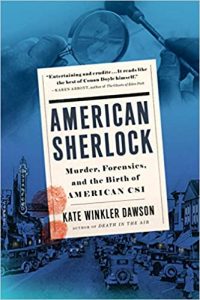
American Sherlock: Murder, Forensics, and the Birth of American CSI

6,000.00

Berkeley, California, 1933. In a lab filled with curiosities–beakers, microscopes, Bunsen burners, and hundreds upon hundreds of books–sat an investigator who would go on to crack at least two thousand cases in his forty-year career. Known as the “American Sherlock Holmes,” Edward Oscar Heinrich was one of America’s greatest–and first–forensic scientists, with an uncanny knack for finding clues, establishing evidence, and deducing answers with a skill that seemed almost supernatural.

Heinrich was one of the nation’s first expert witnesses, working in a time when the turmoil of Prohibition led to sensationalized crime reporting and only a small, systematic study of evidence. However with his brilliance, and commanding presence in both the courtroom and at crime scenes, Heinrich spearheaded the invention of a myriad of new forensic tools that police still use today, including blood spatter analysis, ballistics, lie-detector tests, and the use of fingerprints as courtroom evidence. His work, though not without its serious–some would say fatal–flaws, changed the course of American criminal investigation.

Based on years of research and thousands of never-before-published primary source materials, American Sherlock captures the life of the man who pioneered the science our legal system now relies upon–as well as the limits of those techniques and the very human experts who wield them.

No Easy Day

6,000.00

From the streets of Iraq to the rescue of Captain Richard Phillips in the Indian Ocean, and from the mountaintops of Afghanistan to the third floor of Osama Bin Laden’s compound, operator Mark Owen of the U.S. Naval Special Warfare Development Group—known as SEAL Team Six—has been a part of some of the most memorable special operations in history, as well as countless missions that never made headlines.

No Easy Day puts readers alongside Owen and his fellow SEAL team members as they train for the biggest mission of their lives. The blow-by-blow narrative of the assault, beginning with the helicopter crash that could have ended Owen’s life straight through to the radio call confirming Bin Laden’s death, is an essential piece of modern history.

In No Easy Day, Owen also takes readers into the War on Terror and details the formation of the most elite units in the military. Owen’s story draws on his youth in Alaska and describes the SEALs’ quest to challenge themselves at the highest levels of physical and mental endurance. With boots-on-the-ground detail, Owen describes several missions that illustrate the life and work of a SEAL and the evolution of the team after the events of September 11.

In telling the true story of the SEALs whose talents, skills, experiences, and exceptional sacrifices led to one of the greatest victories in the War on Terror, Mark Owen honors the men who risk everything for our country, and he leaves readers with a deep understanding of the warriors who keep America safe.

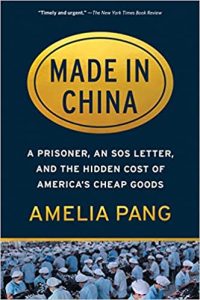
Made In China

6,000.00

Discover the truth behind the discounts.

In 2012, an Oregon mother named Julie Keith opened up a package of Halloween decorations. The cheap foam headstones had been five dollars at Kmart, too good a deal to pass up. But when she opened the box, something shocking fell out: an SOS letter, handwritten in broken English.
“Sir: If you occassionally buy this product, please kindly resend this letter to the World Human Right Organization. Thousands people here who are under the persicuton of the Chinese Communist Party Government will thank and remember you forever.”
The note’s author, Sun Yi, was a mild-mannered Chinese engineer turned political prisoner, forced into grueling labor as punishment for campaigning for the freedom to join a forbidden meditation movement. He was imprisoned alongside petty criminals, civil rights activists, and tens of thousands of others the Chinese government had decided to “reeducate,” carving foam gravestones and stitching clothing for more than fifteen hours a day.

In Made in China, investigative journalist Amelia Pang pulls back the curtain on Sun’s story and the stories of others like him, including the persecuted Uyghur minority group, whose abuse and exploitation is rapidly gathering steam. What she reveals is a closely guarded network of laogai—forced labor camps—that power the rapid pace of American consumerism. Through extensive interviews and firsthand reportage, Pang shows us the true cost of America’s cheap goods and shares what is ultimately a call to action—urging us to ask more questions and demand more answers from the companies we patronize.

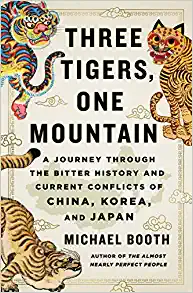
Three Tigers, One Mountain

6,000.00

There is an ancient Chinese proverb that states, “Two tigers cannot share the same mountain.” However, in East Asia, there are three tigers on that mountain: China, Japan, and Korea, and they have a long history of turmoil and tension with each other. In his latest entertaining and thought provoking narrative travelogue, Michael Booth sets out to discover how deep, really, is the enmity between these three “tiger” nations, and what prevents them from making peace. Currently China’s economic power continues to grow, Japan is becoming more militaristic, and Korea struggles to reconcile its westernized south with the dictatorial Communist north. Booth, long fascinated with the region, travels by car, ferry, train, and foot, experiencing the people and culture of these nations up close. No matter where he goes, the burden of history, and the memory of past atrocities, continues to overshadow present relationships. Ultimately, Booth seeks a way forward for these closely intertwined, neighboring nations.

An enlightening, entertaining and sometimes sobering journey through China, Japan, and Korea, Three Tigers, One Mountain is an intimate and in-depth look at some of the world’s most powerful and important countries.

China Syndrome

6,000.00

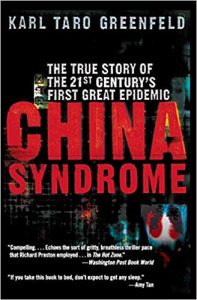
When the SARS virus broke out in China in January 2003, Karl Taro Greenfeld was the editor of Time Asia in Hong Kong, just a few miles from the epicenter of the outbreak. After vague, initial reports of terrified Chinese boiling vinegar to “purify” the air, Greenfeld and his staff soon found themselves immersed in the story of a lifetime.

Deftly tracking a mysterious viral killer from the bedside of one of the first victims to China’s overwhelmed hospital wards—from cutting-edge labs where researchers struggle to identify the virus to the war rooms at the World Health Organization headquarters in Geneva—China Syndrome takes readers on a gripping ride that blows through the Chinese government’s effort to cover up the disease . . . and sounds a clarion call warning of a catastrophe to come: a great viral storm potentially more deadly than any respiratory disease since the influenza of 1918.

The Strange Death Of Europe

6,000.00

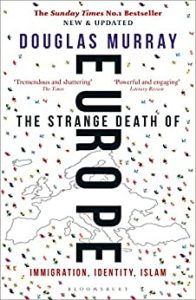
The Strange Death of Europe is the internationally bestselling account of a continent and a culture caught in the act of suicide, now updated with new material taking in developments since it was first published to huge acclaim. These include rapid changes in the dynamics of global politics, world leadership and terror attacks across Europe.

Douglas Murray travels across Europe to examine first-hand how mass immigration, cultivated self-distrust and delusion have contributed to a continent in the grips of its own demise. From the shores of Lampedusa to migrant camps in Greece, from Cologne to London, he looks critically at the factors that have come together to make Europeans unable to argue for themselves and incapable of resisting their alteration as a society. Murray’s “tremendous and shattering” book (The Times) addresses the disappointing failures of multiculturalism, Angela Merkel’s U-turn on migration, the lack of repatriation and the Western fixation on guilt, uncovering the malaise at the very heart of the European culture. His conclusion is bleak, but the predictions not irrevocable. As Murray argues, this may be our last chance to change the outcome, before it’s too late.

The Scientist And The Spy

6,000.00

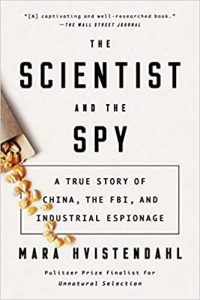
A riveting true story of industrial espionage in which a Chinese-born scientist is pursued by the U.S. government for trying to steal trade secrets, by a finalist for the Pulitzer Prize in nonfiction.

In September 2011, sheriff’s deputies in Iowa encountered three ethnic Chinese men near a field where a farmer was growing corn seed under contract with Monsanto. What began as a simple trespassing inquiry mushroomed into a two-year FBI operation in which investigators bugged the men’s rental cars, used a warrant intended for foreign terrorists and spies, and flew surveillance planes over corn country—all in the name of protecting trade secrets of corporate giants Monsanto and DuPont Pioneer. In The Scientist and the Spy,Hvistendahl gives a gripping account of this unusually far-reaching investigation, which pitted a veteran FBI special agent against Florida resident Robert Mo, who after his academic career foundered took a questionable job with the Chinese agricultural company DBN—and became a pawn in a global rivalry.

Industrial espionage by Chinese companies lies beneath the United States’ recent trade war with China, and it is one of the top counterintelligence targets of the FBI. But a decade of efforts to stem the problem have been largely ineffective. Through previously unreleased FBI files and herreporting from across the United States and China, Hvistendahl describes a long history of shoddy counterintelligence on China, much of it tinged with racism, and questions the role that corporate influence plays in trade secrets theft cases brought by the U.S. government. The Scientist and the Spy is both an important exploration of the issues at stake and a compelling, involving read.

Savage Appetites

6,000.00

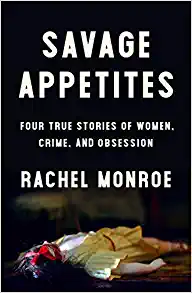
In this illuminating exploration of women, violence, and obsession, Rachel Monroe interrogates the appeal of true crime through four narratives of fixation. In the 1940s, a frustrated heiress began creating dollhouse crime scenes depicting murders, suicides, and accidental deaths. Known as the “Mother of Forensic Science,” she revolutionized the field of what was then called legal medicine. In the aftermath of the Manson Family murders, a young woman moved into Sharon Tate’s guesthouse and, over the next two decades, entwined herself with the Tate family. In the mid-nineties, a landscape architect in Brooklyn fell in love with a convicted murderer, the supposed ringleader of the West Memphis Three, through an intense series of letters. After they married, she devoted her life to getting him freed from death row. And in 2015, a teenager deeply involved in the online fandom for the Columbine killers planned a mass shooting of her own.

Each woman, Monroe argues, represents and identifies with a particular archetype that provides an entryway into true crime. Through these four cases, she traces the history of American crime through the growth of forensic science, the evolving role of victims, the Satanic Panic, the rise of online detectives, and the long shadow of the Columbine shooting. In a combination of personal narrative, reportage, and a sociological examination of violence and media in the twentieth and twenty-first century, Savage Appetites scrupulously explores empathy, justice, and the persistent appeal of violence.

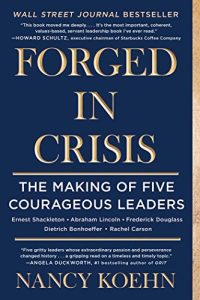
Forged In Crisis

6,000.00

An enthralling historical narrative filled with critical leadership insights, Forged in Crisis, by celebrated Harvard Business School historian Nancy Koehn, spotlights five masters of crisis: polar explorer Ernest Shackleton; President Abraham Lincoln; legendary abolitionist Frederick Douglass; Nazi-resisting clergyman Dietrich Bonhoeffer; and environmental crusader Rachel Carson.

What do such disparate figures have in common? Why do their extraordinary stories continue to amaze and inspire? In delivering the answers to those questions, Nancy Koehn offers a remarkable template by which to judge those in our own time to whom the public has given its trust.

She begins each of the book’s five sections by showing her protagonist on the precipice of a great crisis: Shackleton marooned on an Antarctic ice floe; Lincoln on the verge of seeing the Union collapse; escaped slave Douglass facing possible capture; Bonhoeffer agonizing over how to counter absolute evil with faith; Carson racing against the cancer ravaging her in a bid to save the planet. The narrative then reaches back to each person’s childhood and shows the individual growing—step by step—into the person he or she will ultimately become. Significantly, as we follow each leader’s against-all-odds journey, we begin to glean an essential truth: leaders are not born but made. In a book dense with epiphanies, the most galvanizing one may be that the power to lead courageously resides in each of us.

Whether it’s read as a repository of great insight or as exceptionally rendered human drama, Forged in Crisis stands as a towering achievement.

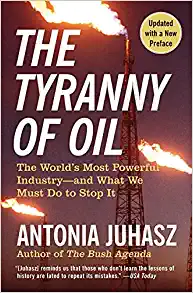
The Tyranny Of Oil

5,500.00

In the tradition of the Academy Award-winning documentary An Inconvenient Truth, Antonia Juhasz’s The Tyranny of Oil offers a chilling exposé of the modern American oil industry and its dire abuse of power. A leading international trade and finance policy expert and the author of The Bush Agenda, Juhasz presents eye-opening truths about a potentially catastrophic global energy crisis that only promises to get much worse in the coming years—and provides possible solutions for meaningful change.

The Innocent Man

5,500.00

In the town of Ada, Oklahoma, Ron Williamson was going to be the next Mickey Mantle. But on his way to the Big Leagues, Ron stumbled, his dreams broken by drinking, drugs, and women. Then, on a winter night in 1982, not far from Ron’s home, a young cocktail waitress named Debra Sue Carter was savagely murdered. The investigation led nowhere. Until, on the flimsiest evidence, it led to Ron Williamson. The washed-up small-town hero was charged, tried, and sentenced to death—in a trial littered with lying witnesses and tainted evidence that would shatter a man’s already broken life, and let a true killer go free.

Impeccably researched, grippingly told, filled with eleventh-hour drama, The Innocent Man reads like a page-turning legal thriller. It is a book no American can afford to miss.

A Guide To Solo Travel

5,000.00

A Guide to Solo Travel is a book that provides tips for navigating the hassles of first-time international travel. It covers making a checklist, getting visas, booking flights, and planning departures. It also covers entry requirements and arriving in your destination country.

Each chapter in this book is divided into two parts. The first part discusses the chapter’s topic and offers valuable suggestions. The second part, separated by asterisks, shares my personal experiences abroad. These experiences align with the chapter’s central theme.

I Am Madam X

5,000.00

When John Singer Sargent unveiled Madame X — his famous portrait of American beauty Virginie Gautreau — at the 1884 Paris Salon, its subject’s bold pose and provocative dress shocked the public and the critics, smashing Sargent’s dreams of a Paris career.

In this remarkable novel, Gioia Diliberto tells Virginie’s story, drawing on the sketchy historical facts to re-create Virginie’s tempestuous personality and the captivating milieu of nineteenth-century Paris. Born in New Orleans and raised on a lush plantation, Virginie fled to France during the Civil War, where she was absorbed into the fascinating and wealthy world of grand ballrooms, dressmakers’ salons, and artists’ ateliers. Even before Sargent painted her portrait, Virginie’s reputation for promiscuity and showy self-display made her the subject of vicious Paris gossip.

Immersing the reader in Belle Epoque Paris, I Am Madame X is a compulsively readable and richly imagined novel illuminating the struggle between Virginie and Sargent over the outcome of a painting that changed their lives and affected the course of art history.

The Mafia

5,000.00

Drawing on two decades of original research and personal experience, multi award-winning writer the late George Carpozi Jr and William Balsamo, great nephew of the first godfather, Don Guiseppe ‘Battista’ Balsamo, trace the Mafia’s beginnings from an underground patriotic society which sprang up six hundred years ago in Sicily, through the group of Italian immigrants – the Black Hand – who savagely tore control of New York’s waterfronts away from the Irish racketeers, to the Mob which went on to run organised crime throughout Italy and America, and whose insidious influence even reached into a presidential administration.

The Mafia has long been one of the most mythical and misunderstood criminal organisations. This book, with filmic detail, behind-closed-doors dialogue and first-hand story-telling, gets deeper inside it than ever before.

Compulsively chilling, The Mafia: The First 100 Years reads like the best crime fiction, yet is the terrifying, deadly truth.

American Sketches

5,000.00

One of America’s most versatile writers, author of bestselling biographies such as Steve Jobs and Benjamin Franklin, has assembled a gallery of portraits of (mostly) Americans that celebreate genius, talent, and versatility, and traces his own education as a writer and biographer.

In this collection of essays, the brilliant, acclaimed biographer Walter Isaacson reflects on lessons to be learned from Benjamin Franklin, Albert Einstein, Bill Gates, Henry Kissinger, Ronald Reagan and Mikhail Gorbachev, Hillary Clinton and Bill Clinton, and other interesting characters he has chronicled both as biographer and journalist. The people he writes about have an awesome intelligence, but that is not the secret to their success. They had qualities that were even more rare, such as imagination and true curiousity.

Isaacson also reflects on how he became a writer, the lessons he learned from various people he met, and the challenges for journalism in the digital age.

He also offers loving tributes to his hometown of New Orleans, which offers many of the ingredients for a creative culture, and to the Louisiana novelist Walker Percy, who was an early mentor. In an anecdotal and personal way, Isaacson describes the joys of writing and the way that tales about the lives of fascinating people can enlighten our own lives.

1 9 10 11