Paperback


₦7,000.00
Cocaine
The story of cocaine isn’t just about crime and profit; it’s about psychoanalysis, about empire building, about exploitation, emancipation, and, ultimately, about power. To tell the story of the twentieth century without reference to this drug and its contribution is to miss a vital and fascinating strand of social history. Streatfeild examines the story of cocaine from its first medical uses to the worldwide chaos it causes today. His research takes him from the arcane reaches of the British Library to the isolation cells of America’s most secure prisons; from the crackhouses of New York to the jungles of Bolivia and Colombia.
Out of stock
Related products
Up All Night: Ted Turner, CNN, and the Birth of 24-Hour News
₦7,500.00The wild inside story of the birth of CNN and dawn of the age of 24-hour news
How did we get from an age of dignified nightly news broadcasts on three national networks to the age of 24-hour news channels and constantly breaking news? The answer—thanks to Ted Turner and an oddball cast of cable television visionaries, big league rejects, and nonunion newbies—can be found in the basement of an abandoned country club in Atlanta. Because it was there, in the summer of 1980, that this motley crew launched CNN.
Lisa Napoli’s Up All Night is an entertaining inside look at the founding of the upstart network that set out to change the way news was delivered and consumed, and succeeded beyond even the wildest imaginings of its charismatic and uncontrollable founder. Mixing media history, a business adventure story, and great characters, this is a fun book on the making of the world we live in now.
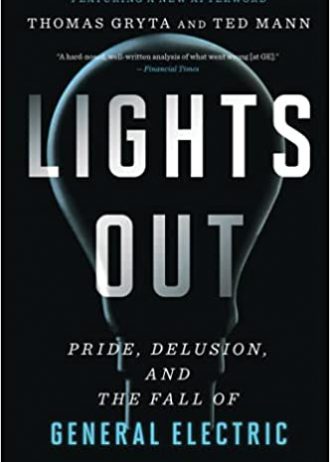
Lights Out
₦10,000.00This is the definitive history of General Electric’s epic decline, as told by the two Wall Street Journal reporters who covered its fall.
Since its founding in 1892, GE has been more than just a corporation. For generations, it was job security, a solidly safe investment, and an elite business education for top managers.
GE electrified America, powering everything from lightbulbs to turbines, and became fully integrated into the American societal mindset as few companies ever had. And after two decades of leadership under legendary CEO Jack Welch, GE entered the twenty-first century as America’s most valuable corporation. Yet, fewer than two decades later, the GE of old was gone.
Lights Out examines how Welch’s handpicked successor, Jeff Immelt, tried to fix flaws in Welch’s profit machine, while stumbling headlong into mistakes of his own. In the end, GE’s traditional win-at-all-costs driven culture seemed to lose its direction, which ultimately caused the company’s decline on both a personal and organizational scale. Lights Out details how one of America’s all-time great companies has been reduced to a cautionary tale for our times.
The Cartiers
₦13,000.00The Cartiers is the revealing tale of a jewelry dynasty—four generations, from revolutionary France to the 1970s. At its heart are the three Cartier brothers whose motto was “Never copy, only create” and who made their family firm internationally famous in the early days of the twentieth century, thanks to their unique and complementary talents: Louis, the visionary designer who created the first men’s wristwatch to help an aviator friend tell the time without taking his hands off the controls of his flying machine; Pierre, the master dealmaker who bought the New York headquarters on Fifth Avenue for a double-stranded natural pearl necklace; and Jacques, the globe-trotting gemstone expert whose travels to India gave Cartier access to the world’s best rubies, emeralds, and sapphires, inspiring the celebrated Tutti Frutti jewelry.
Francesca Cartier Brickell, whose great-grandfather was the youngest of the brothers, has traveled the world researching her family’s history, tracking down those connected with her ancestors and discovering long-lost pieces of the puzzle along the way. Now she reveals never-before-told dramas, romances, intrigues, betrayals, and more.
The Cartiers also offers a behind-the-scenes look at the firm’s most iconic jewelry—the notoriously cursed Hope Diamond, the Romanov emeralds, the classic panther pieces—and the long line of stars from the worlds of fashion, film, and royalty who wore them, from Indian maharajas and Russian grand duchesses to Wallis Simpson, Coco Chanel, and Elizabeth Taylor.
The Man Who Knew
₦8,000.00Greenspan’s life is a quintessential American success story: raised by a single mother in the Jewish émigré community of Washington Heights, he was a math prodigy who found a niche as a stats-crunching consultant. A master at explaining the economic weather to captains of industry, he translated that skill into advising Richard Nixon in his 1968 campaign. This led to a perch on the White House Council of Economic Advisers, and then to a dazzling array of business and government roles, from which the path to the Fed was relatively clear. A fire-breathing libertarian and disciple of Ayn Rand in his youth who once called the Fed’s creation a historic mistake, Mallaby shows how Greenspan reinvented himself as a pragmatist once in power. In his analysis, and in his core mission of keeping inflation in check, he was a maestro indeed, and hailed as such. At his retirement in 2006, he was lauded as the age’s necessary man, the veritable God in the machine, the global economy’s avatar. His memoirs sold for record sums to publishers around the world.
But then came 2008. Mallaby’s story lands with both feet on the great crash which did so much to damage Alan Greenspan’s reputation. Mallaby argues that the conventional wisdom is off base: Greenspan wasn’t a naïve ideologue who believed greater regulation was unnecessary. He had pressed for greater regulation of some key areas of finance over the years, and had gotten nowhere. To argue that he didn’t know the risks in irrational markets is to miss the point. He knew more than almost anyone; the question is why he didn’t act, and whether anyone else could or would have. A close reading of Greenspan’s life provides fascinating answers to these questions, answers whose lessons we would do well to heed. Because perhaps Mallaby’s greatest lesson is that economic statesmanship, like political statesmanship, is the art of the possible. The Man Who Knew is a searching reckoning with what exactly comprised the art, and the possible, in the career of Alan Greenspan.
The Power of Why
₦4,000.00The urge to question is natural for small children—just ask any parent. But few of us are aware that it is also one of the most vital tools for success. In The Power of Why, Amanda Lang shows how curiosity and the ability to ask the right questions fuels innovation and can drive change not just in business but also in our personal lives.
Weaving together the latest research with in-depth profiles of innovators from around the world, Lang explores how to harness and develop the power of curiosity. She reveals how a major retailer set out to discover what really makes men happy—and was stunned by the results. She finds out why, at one particular hospital, nurses think it’s better if they don’t wash their hands. She learns why the most common methods of brainstorming don’t actually work and discovers a new soccer ball that could change the world.
A book that challenges conventional wisdom and offers practical, inspiring advice, The Power of Why shows how it’s possible to reignite your innate curiosity and overcome long-standing barriers—leaving you more creative, productive and fulfilled in your job and happier in your relationships.
Reviews
There are no reviews yet.