Biography & Autobiography

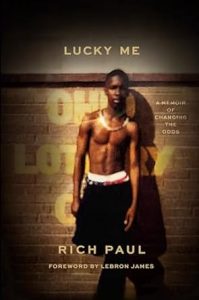
Lucky Me

25,000.00

There’s a story about Rich Paul that everyone knows: A twenty-one-year-old kid from Cleveland who sells sports jerseys out of his car meets a high school basketball phenom named LeBron James at an airport—the two become friends and forge a decades-long partnership that reinvents the business of sports. That random meeting might seem like the lucky break that changed Paul’s life. But a moment of good fortune means nothing without the struggle that gets you there. And the truth is, Paul had always been lucky.

Rich Paul became a gambler at an early age—his fast mind and gift for finding an edge made him a devastating dice roller who could hold his own with grown men, win big, and walk away alive. Shooting dice wasn’t just a pastime; it was a way to earn money for his family as his mother struggled under the weight of drug addiction. He learned the secret science of dice in the same place he found all the lessons of his young life: the corner store his father operated, the center of the neighborhood’s frantic action. Paul’s father had another family but kept his son close working at the store. Paul dreamed of becoming a star athlete, but the streets were where he thrived, building a lucrative enterprise on shaky ground. When he found himself at a dangerous crossroads, he summoned the teachings of his past to create a different future.

Readers will follow the riveting journey of a young Rich Paul narrated by the Paul of today, who looks back with wit and insight, drawing out the lessons he learned at every stage—about business, people, and the values that lead to success. It’s the inspiring story of the luck that’s all around us, if we know where to look.

Narcas: The Secret Rise of Women in Latin America’s Cartels

25,000.00

VICE journalist Deborah Bonello reports from the trenches in this first-ever in-depth exploration of the hidden power women wield in Latin American drug cartels

You’ve heard of Pablo Escobar, Joaquin “El Chapo” Guzman, and Rafael Caro Quintero. Their names conjure ghoulish images of bloody streets, white powder, bundles of weed, and a particular flavor of machismo unique to ruthless druglords. But what of the drugladies, las narcas? For the first time, investigative reporter Deborah Bonello takes you behind the curtain to introduce the women at the helm of organized crime south of the US-Mexico border. These women are the powerhouses behind violent cartels; masterminds of extortion rackets; right-hand ladies to El Chapo’s cocaine flow to the US; and matriarchs of major drug trafficking families. In these pages, you will meet women like Doña Digna, the leader of the Valle cartel, and Guadalupe Fernandez Valencia, one of “El Chapo” Guzman’s closest confidants.

Narcas, for the first time, gives voice to the women of notorious drug-trafficking monarchies, meticulously documenting the variety of roles they play. Bonello chronicles the complexity of their actions and their desires, the grey chasm between victims and victimizers, co-option and agency, and right and wrong. She examines why women’s experiences are under-reported, emphasizing the importance of understanding women as fully capable beings who are often as ambitious, innovative, ruthless, and violent as their male counterparts.

With careful detail, comprehensive research, and groundbreaking storytelling, Narcas paints a vivid picture of the women behind some of the most notorious drug cartels. You will not see Sebastiana Cottón or Marixa Lemus in the stereotypical portrayals of beautiful narco wives or girlfriends, or in the faces of trafficking survivors or drug mules. Rather, you’ll encounter—at staggering rates—the female cartel killers, money launderers, logistical heads, and transporters of Latin America’s infamous crime syndicates.

American Prometheus

20,000.00

#1 NEW YORK TIMES BESTSELLER • PULITZER PRIZE WINNER • The definitive biography of J. Robert Oppenheimer, one of the iconic figures of the twentieth century, a brilliant physicist who led the effort to build the atomic bomb for his country in a time of war, and who later found himself confronting the moral consequences of scientific progress.

In this magisterial, acclaimed biography twenty-five years in the making, Kai Bird and Martin Sherwin capture Oppenheimer’s life and times, from his early career to his central role in the Cold War. This is biography and history at its finest, riveting and deeply informative.

Black Chameleon

20,000.00

Growing up as a Black girl in America, Deborah D.E.E.P. Mouton yearned for stories she could connect to―true ones, of course, but also fables and mythologies that could help explain both the world and her place in it. Greek and Roman myths felt as dusty and foreign as ancient ruins, and tales by Black authors were often rooted too far in the past, a continent away.

Mouton’s memoir is a praise song and an elegy for Black womanhood. She tells her own story while remixing myths and drawing on traditions from all over the world: mothers literally grow eyes in the backs of their heads, children dust the childhood off their bodies, and women come to love the wildness of the hair they once tried to tame. With a poet’s gift for lyricism and poignancy, Mouton reflects on her childhood as the daughter of a preacher and a harsh but loving mother, living in the world as a Black woman whose love is all too often coupled with danger, and finally learning to be a mother to another Black girl in America.

Of the moment yet timeless, playful but incendiary, Mouton has staked out new territory in the memoir form.

Didn’t We Almost Have It All: In Defense of Whitney Houston

20,000.00

On February 11, 2012, Whitney Houston was found submerged in the bathtub of her suite at the Beverly Hilton Hotel. Since then, the world has mourned her death amid new revelations about her relationship to her Blackness, her sexuality, and her addictions. Didn’t We Almost Have It All is award-winning journalist Gerrick Kennedy’s exploration of the duality of Whitney’s life as both a woman in the spotlight and someone who often had to hide who she was. This is the story of Whitney’s life—her whole life—told with both grace and honesty.

Long before that fateful day in 2012, Whitney split the world wide open with her voice. Hers was a once-in-a-generation talent forged in Newark, New Jersey, and blessed with the grace of the church and the wisdom of a long lineage of famous gospel singers. She redefined “The Star-Spangled Banner.” She became a box-office powerhouse, a queen of the pop charts, and an international superstar. But all the while, she was forced to rein in who she was amid constant accusations that her music wasn’t Black enough, original enough, honest enough.

Kennedy deftly peels back the layers of Whitney’s complex story to get to the truth at the core of what drove her, what inspired her, and what haunted her. He pulls the narrative apart into the key elements that informed her life—growing up in the famed Drinkard family; the two romantic relationships that shaped the entirety of her adult life: Robyn Crawford and Bobby Brown; her fraught relationship to her own Blackness and the ways in which she was judged by the Black community; her drug and alcohol addiction; and, finally, the shame that she carried in her heart, which informed every facet of her life. Drawing on hundreds of sources, Kennedy takes readers back to a world in which someone like Whitney simply could not be, and explains in excruciating detail the ways in which her fame did not and could not protect her.

In the time since her passing, the world and the way we view celebrity have changed dramatically. A sweeping look at Whitney’s life, Didn’t We Almost Have It All contextualizes her struggles against the backdrop of tabloid culture, audience consumption, mental health stigmas, and racial divisions in America. It explores exactly how and why we lost a beloved icon far too soon.

The Child Is The Teacher

20,000.00

Born in 1870 in Chiaravalle, Italy, Maria Montessori would grow up to embody almost every trait men of her era detested in the fairer sex. She was self-confident, strong-willed, and had a fiery temper at a time when women were supposed to be soft and pliable. She studied until she became a doctor at a time when female graduates in Italy provoked outright scandal. She never wanted to marry or have children—the accepted destiny for all women of her milieu in late nineteenth-century bourgeois Rome—and when she became pregnant by a colleague of hers, she gave up her son to continue pursuing her career.

At around age thirty, Montessori was struck by the condition of children in the slums of Rome’s San Lorenzo neighborhood, and realized what she wanted to do with her life: change the school, and therefore the world, through a new approach to the child’s mind. In spite of the resistance she faced from all sides—scientists accused her of being too mystical, and the clergy of being too scientific, traditionalists of giving children too much freedom, and anarchists of giving them too much structure—she would garner acclaim and establish the influential Montessori method, which is now practiced throughout the world.

A thorough, nuanced portrait of this often controversial woman, The Child Is the Teacher offers an unbiased perspective from an author who is not a member of the Montessori movement, but who has been granted access to original letters, diaries, notes, and texts written by Montessori herself, including an array of previously unpublished material.

The Black Period

20,000.00

“I say, ‘the Black Period,’ and mean ‘home’ in all its shapeshifting ways.” In The Black Period, Hafizah creates a space for the beauty of Blackness, Islam, disability, and queerness to flourish, celebrating the many layers of her existence that America has time and again sought to erase.

At nineteen, she lost her mother to a sudden stroke. Weeks later, her father became so heartsick that he needed a triple bypass. By her thirties, she was constantly in pain, pinballing between physical therapy appointments, her grief, and the grind that is the American Dream. Hafizah realized she’d spent years internalizing the narratives that white supremacy had fed her about herself. Suddenly, she says, I was standing at the cliff of my own life, remembering.

Recalling her parents’ lessons on the art of Black revision, and mixing history, political analysis, and cultural criticism, alongside 70+ stunning original artworks created by her father, renowned artist Tyrone Geter, Hafizah maps out her own narrative, weaving between a childhood populated with Southern and Nigerian relatives; her days in a small Catholic school; a loving but tragically short relationship with her mother; and the feelings of joy and community that the Black Lives Matter protests engendered in her as an adult. All throughout, she forms a new personal and collective history, addressing the systems of inequity that make life difficult for non-able-bodied persons, queer people, and communities of color while capturing a world brimming with potential, art, music, hope, and love.

A unique combination of gripping memoir and Afrofuturist thought, in The Black Period, Hafizah manages to sidestep shame, confront disability, embrace forgiveness, and emerge from the erasures America imposes to exist proudly and unabashedly as herself.

Brutally Frank

20,000.00

Brutally Frank is the autobiography of an elder statesman and frontline advocate of truth, fairness, justice, and equity in Nigeria, Chief (Dr.) Edwin Kiagbodo Clark, OFR, CON. Written in a simple language, the book tells the story of Edwin Clark right from his forebears till his present. But beyond being the story of just a man and his life, Edwin Clark’s story intersects with those of the Ijaws, the Urhobos, and the entire Niger Delta on one hand, and the Nigerian nation on the other hand. Therefore, in this book, the history of Nigeria and the vital events that contributed to its current outlook are captured and told as they are in a brutally frank manner!

Furthermore, important facts and salient truths which must be stated, understood, and appreciated should Nigeria desire to move forward and reclaim its rightful place in the comity of nations are well articulated by Chief Clark in this book.

My Life In Full

20,000.00

An intimate and powerful memoir by the trailblazing former CEO of PepsiCo

For a dozen years as one of the world’s most admired CEOs, Indra Nooyi redefined what it means to be an exceptional leader. The first woman of color and immigrant to run a Fortune 50 company — and one of the foremost strategic thinkers of our time — she transformed PepsiCo with a unique vision, a vigorous pursuit of excellence, and a deep sense of purpose. Now, in a rich memoir brimming with grace, grit, and good humor, My Life in Full offers a firsthand view of Nooyi’s legendary career and the sacrifices it so often demanded.

Nooyi takes us through the events that shaped her, from her childhood and early education in 1960s India, to the Yale School of Management, to her rise as a corporate consultant and strategist who soon ascended into the most senior executive ranks. The book offers an inside look at PepsiCo, and Nooyi’s thinking as she steered the iconic American company toward healthier products and reinvented its environmental profile, despite resistance at every turn.

For the first time and in raw detail, Nooyi also lays bare the difficulties that came with managing her demanding job with a growing family, and what she learned along the way. She makes a clear, actionable, urgent call for business and government to prioritize the care ecosystem, paid leave and work flexibility, and a convincing argument for how improving company and community support for young family builders will unleash the economy’s full potential.

Generous, authoritative, and grounded in lived experience, My Life in Full is the story of an extraordinary leader’s life, a moving tribute to the relationships that created it, and a blueprint for 21st century prosperity.

The Will To Win: The Story of Biodun Shobanjo (Hardback)

20,000.00

The Will to Win: The Story of Biodun Shobanjo is fundamentally a deliberative evaluation of leadership and enterprise management. It is as much a biographical portrait of Nigeria’s ‘Czar of Advertising’ as it is a story of the major developments in the world of marketing communications in Nigeria as it involves Shobanjo. It sheds light on his persona and gives a comprehensive overview of who he is. It is a lucidly engaging work through which the reader understands his parentage, family life and most poignantly, his professional and business life. In a land with few authentic heroes or achievers, Biodun Shobanjo’s contributions, achievements and place are deservedly presented. The avalanche of information provided, the depth of treatment given to it, and the sources consulted make this work a productive venture. The reader is assured of an excursion in history, career development, ambition, decision – making, entrepreneurship, business management, office politics, people management, success and failure. It is a positive work that is faithful to its theme: the path to success is guided by the will to win.

The Scandal Of The Century

19,000.00

From one of the titans of twentieth-century literature, collected here for the first time: a selection of his journalism from the late 1940s to the mid-1980s–work that he considered even more important to his legacy than his universally acclaimed works of fiction.

“I don’t want to be remembered for One Hundred Years of Solitude or for the Nobel Prize but rather for my journalism,” Gabriel García Márquez said in the final years of his life. And while some of his journalistic writings have been made available over the years, this is the first volume to gather a representative selection from across the first four decades of his career–years during which he worked as a full-time, often muckraking, and controversial journalist, even as he penned the fiction that would bring him the Nobel Prize in 1982.

Here are the first pieces he wrote while working for newspapers in the coastal Colombian cities of Cartagena and Barranquilla . . . his longer, more fictionlike reportage from Paris and Rome . . . his monthly columns for Spain’s El País. And while all the work points in style, wit, depth, and passion to his fiction, these fifty pieces are, more than anything, a revelation of the writer working at the profession he believed to be “the best in the world.”

Churchill: Walking With Destiny

19,000.00

In this landmark biography of Winston Churchill based on extensive new material, the true genius of the man, statesman and leader can finally be fully seen and understood–by the bestselling, award-winning author of Napoleon and The Last King of America.

When we seek an example of great leaders with unalloyed courage, the person who comes to mind is Winston Churchill: the iconic, visionary war leader immune from the consensus of the day, who stood firmly for his beliefs when everyone doubted him. But how did young Winston become Churchill? What gave him the strength to take on the superior force of Nazi Germany when bombs rained on London and so many others had caved? In Churchill, Andrew Roberts gives readers the full and definitive Winston Churchill, from birth to lasting legacy, as personally revealing as it is compulsively readable.

Roberts gained exclusive access to extensive new material: transcripts of War Cabinet meetings, diaries, letters and unpublished memoirs from Churchill’s contemporaries. The Royal Family permitted Roberts–in a first for a Churchill biographer–to read the detailed notes taken by King George VI in his diary after his weekly meetings with Churchill during World War II. This treasure trove of access allows Roberts to understand the man in revelatory new ways, and to identify the hidden forces fueling Churchill’s legendary drive.

We think of Churchill as a hero who saved civilization from the evils of Nazism and warned of the grave crimes of Soviet communism, but Roberts’s masterwork reveals that he has as much to teach us about the challenges leaders face today–and the fundamental values of courage, tenacity, leadership and moral conviction.

1 2 3 22